
1-805-484-2992
Quotes - Engineering - Sales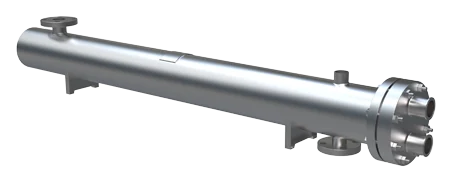
BEU and BEUB Sanitary Steam Heaters
| PRODUCT | TYPE | STYLE | RATING |
|---|---|---|---|
| Sanitary Heater | U-Tube BEU | Steam-to-Liquid | ASME / TEMA C |
Specifications
Configuration & Size
Stock shells:
4", 6", 8" and 10"
Stock lengths:
36" to 72"
Surface area:
About 8.8 to 70.3 sq ft
Tube side:
Two-pass, 1-1/2" to 4" tri-clamp
Shell side:
Steam in 1-1/2" to 4" NPT, condensate out 1" to 2" NPT
Configurations:
Ten stock, about 32 standard
Materials
- Stock units: 304L stainless
- 3-A stock unit: 316L/304L, 8" x 54"
- Standard units: 316L/304L
- Seals: O-rings on the removable bundle
- 3-A finish: 32 Ra or better on product contact
Off the shelf when a heater fails
Ten stock sizes, about 32 standard designs behind them
These are the heaters found on CIP skids, product lines and hot water sets in food, dairy, beverage and pharmaceutical plants. Each one is a TEMA BEU: a bonnet front head, a one-pass shell and a U-tube bundle. Steam goes on the shell through NPT connections, and product runs through the tubes in two passes between sanitary tri-clamp ends. The bundle slides out of the shell and seals on O-rings, so a damaged one can be swapped instead of scrapping the exchanger. Every stock unit is ASME code stamped and hydro-tested before it reaches the shelf.
Buyers name these units by shell diameter and length in inches. A 4x36 is a 4" shell 36" long, the smallest stock unit; an 8x54 is an 8" shell 54" long, the size that also comes as the stock 3-A model in 316L/304L. If the old nameplate is gone, measure the shell outside diameter and the overall length and note the tri-clamp and NPT connection sizes; that is usually enough for us to identify the match. Stock units often ship the next business day.
When no stock size fits, the standard line covers about 32 configurations from 4x24 up to 12x108, with roughly 5.9 to 163.5 sq ft of surface. Standard units are 316L/304L, two-pass on 4" shells and two- or four-pass on 6" through 12", with NPT and tri-clamp connections from 1-1/2" to 6", and they can meet 3-A. They are made to order from a fixed design and typically ship in 6 to 8 weeks. Select 8" units carry a national CRN for sites in Canada.
Send the size, the nameplate or the old drawing and we will confirm whether a stock unit fits.
Request a QuoteBuilt Into Every Unit



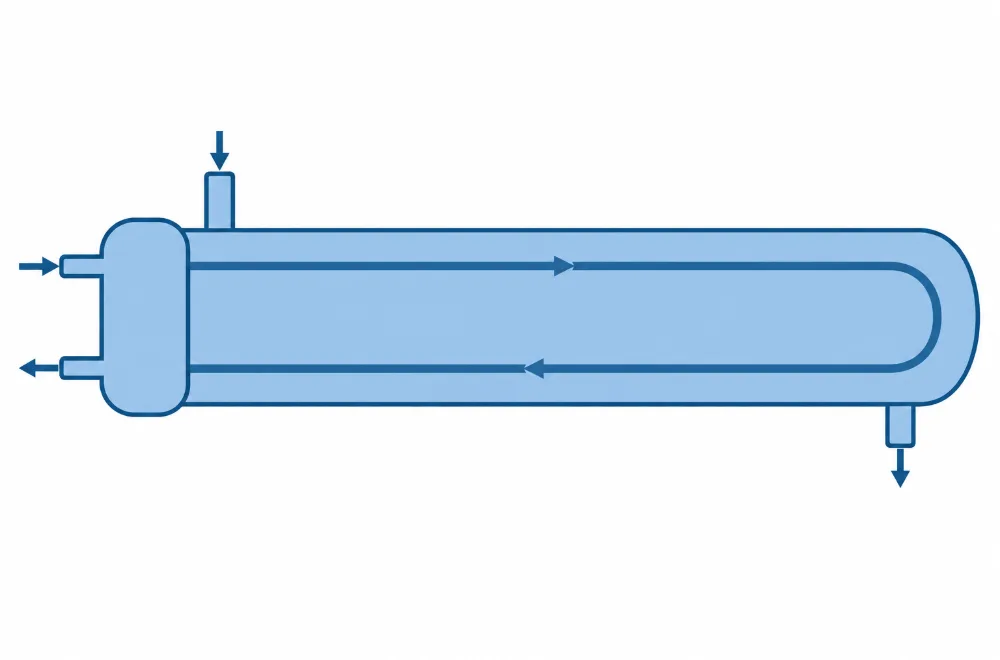
How steam and product move through a BEU
Steam enters the shell through the upper NPT inlet and spreads around the outside of the U-tubes. Where it touches the cooler tube walls it condenses and gives up its latent heat, and the condensate runs down to the lower NPT outlet and on to a steam trap. Condensing steam holds one temperature at a given pressure, so the heat delivered is controlled by regulating steam pressure. The outlet is smaller than the inlet because condensate takes far less room than the steam it came from.
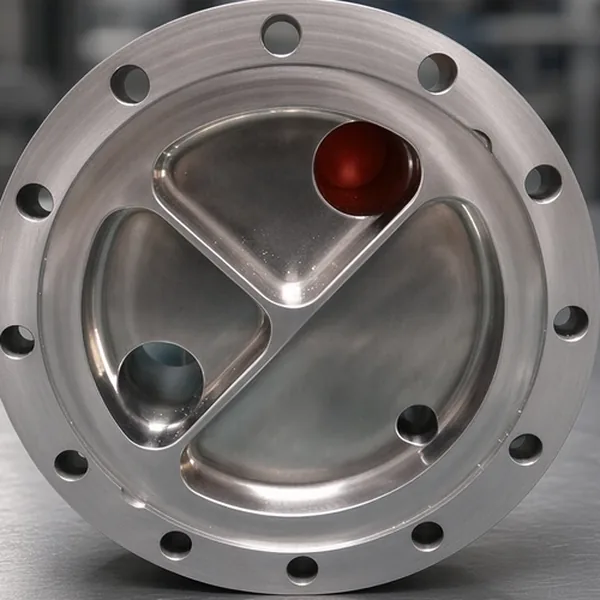
Product enters a tri-clamp nozzle on the bonnet. A pass partition sends it down one leg of the U-tubes, around the bend and back along the other leg to the outlet on the same bonnet: two passes, one head. Keeping product in the tubes is what makes the unit sanitary, because the tube bore is smooth, drainable and reachable by CIP. The U-bends float free inside the shell, so tubes and shell can grow at different rates without straining the tubesheet.
Stock Unit Questions
Start with stock. If one of the ten sizes carries the duty, it is the fastest and lowest-cost route, and next business day shipment is often realistic. Move to a standard unit when you need 316L/304L construction, 3-A on a size other than the 8x54, four passes for tube velocity, more than 70.3 sq ft, or a 12" shell, and plan on 6 to 8 weeks. Go custom when the duty is not steam-to-liquid, the fluid needs another alloy, or the connections fall outside the standard designs.
Set the trap below the condensate outlet so the shell drains by gravity. A trap that backs up floods the lower tubes, which cuts surface and brings water hammer when the steam valve opens again. If the control valve throttles down to low flow, add a vacuum breaker: collapsing steam can pull a vacuum on the shell and hold condensate inside it. Keep the steam supply within the design conditions stamped on the nameplate.
Mount the unit so both sides drain, the tube side toward the product outlet and the shell side toward the condensate connection. Leave clear space beyond the bonnet end at least equal to the bundle length, so the bundle can be withdrawn without moving the shell or the piping around it. Support the product lines on their own hangers; a tri-clamp joint is not meant to carry pipe weight, and a sagging line will work the gasket loose.
When a stock unit leaks, first decide whether the shell is sound. If it is, a replacement bundle with fresh O-rings restores the exchanger for much less than a new unit, and bundles for these sizes are kept in stock and shipped quickly. If the shell is pitted or a nozzle is damaged, a complete stock unit is often the quicker fix. For an exchanger from another maker, send the nameplate, a drawing or the U-1 data report and we will match a drop-in bundle to its dimensions.
The ranges below cover what is held in stock and what the standard line adds. Give us the shell diameter and length and we will confirm the exact match.
- Stock shells: 4", 6", 8" and 10"
- Stock lengths: 36" to 72", smallest unit 4" x 36"
- Stock surface: about 8.8 to 70.3 sq ft across ten configurations
- Stock 3-A model: one 8" x 54" BEUB-3A-S unit in 316L/304L
- Stock connections: steam 1-1/2" to 4" NPT, condensate 1" to 2" NPT, product 1-1/2" to 4" tri-clamp
- Standard sizes: about 32 configurations from 4" x 24" to 12" x 108"
- Standard surface: about 5.9 to 163.5 sq ft
- Standard passes: two on 4" shells, two or four on 6" to 12"
- Standard connections: NPT and tri-clamp, 1-1/2" to 6"
- Lead time: stock often next business day, standard typically 6 to 8 weeks