
1-805-484-2992
Quotes - Engineering - SalesHolding every batch at the right temperature
Mixing, blending, emulsifying and filling lotions, shampoos and pet food
Personal care and pet care plants look nothing alike on the floor, yet they share one thermal problem. Mixing, blending, emulsifying and filling each work only when the product arrives at the temperature the formula expects. A lotion that is too warm at the filler sags in the bottle; a shampoo base that is too cool takes its next ingredient unevenly. Shell-and-tube heaters and coolers hold that temperature on large and small batches alike.
Product goes through polished 316L tubes while steam, hot water, chilled water or glycol runs on the shell. That handles creams, conditioners and thick pet food slurries that would struggle in a narrow channel, and the tube side can be checked after cleaning through a sight glass or with a borescope down the bore.
Enerquip builds this equipment in Medford, Wisconsin, in a shop that handles stainless only, with passivation and electropolishing done in-house. The polish and double tubesheet options that serve pharmaceutical customers are available on personal care units too, and when the duty is a plain steam-to-liquid heater, a stock unit often ships the next business day.
Request a Quote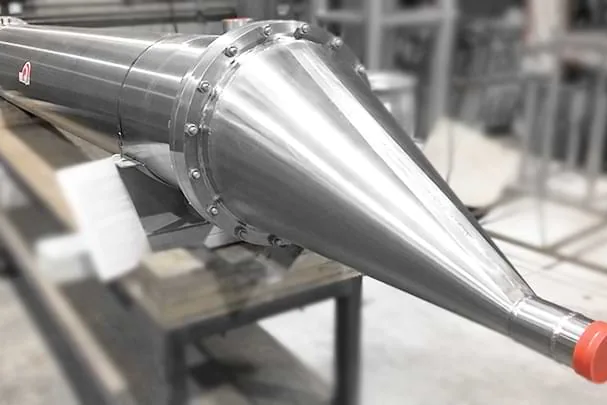
An emulsion is only as stable as its temperature control
Oil and water phases have to meet within a narrow band, then cool steadily while viscosity climbs. Utilities stay on the shell; product runs in tubes polished to 32 Ra or better.
Lotions, creams and shampoos
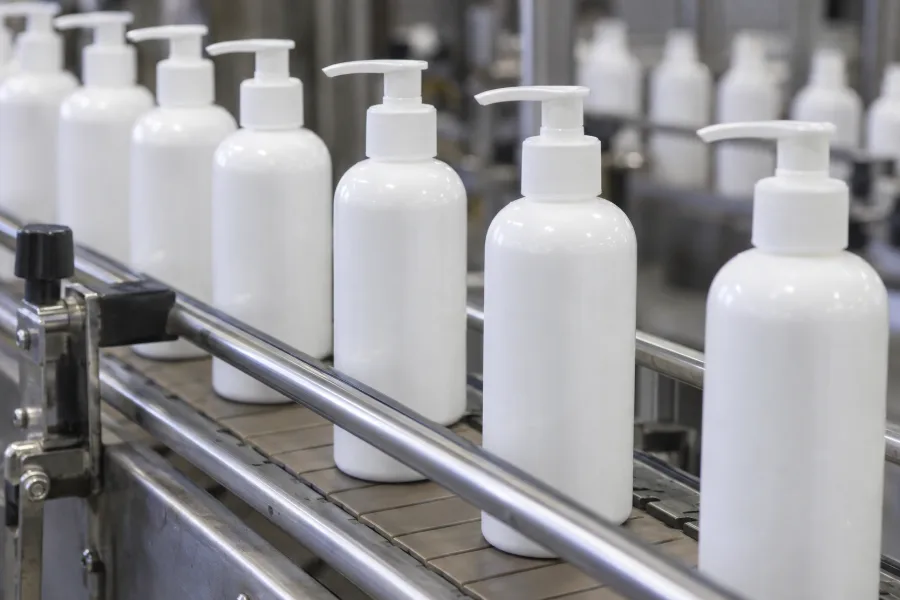
- Heating oil and wax phases before emulsifying
- Cooling batches ahead of the filling line
- More tube passes for thick creams and gels
- Product contact polished to 32 Ra or better
- Electropolish to 15 Ra where residue lingers
Wet and dry pet food
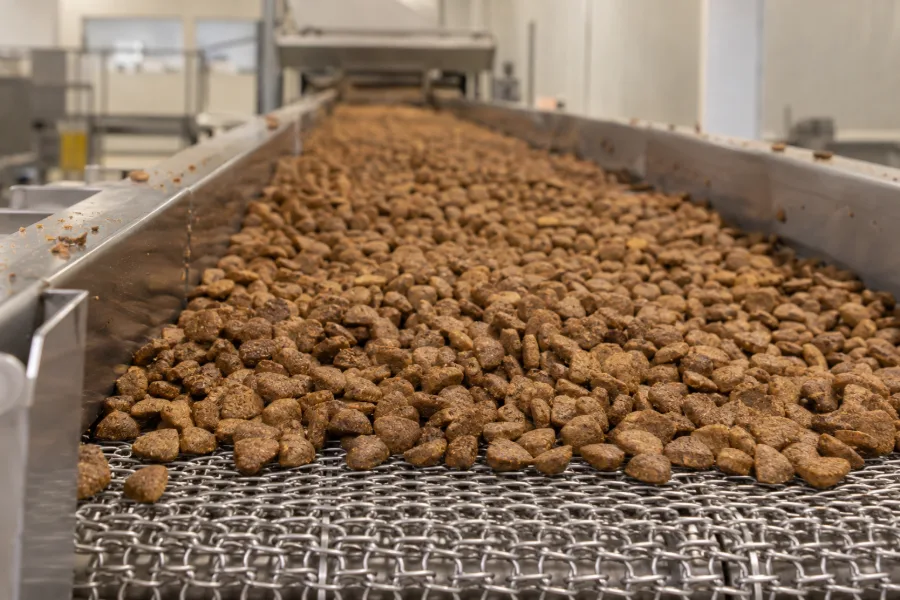
- Heating meat, vegetable and grain mix to can
- Cooling dry mix before extrusion into kibble
- Bayonet heaters for tallow and fat tanks
- Straight tubes sized around particle size
- Tri-clamp bonnets come off for inspection
Matching equipment to personal and pet care duties
Five duties that come up in cosmetics, toiletry and pet food plants, with the Enerquip unit we would quote first. Wherever a stock heater will carry the duty, it is listed ahead of a custom design.
| DUTY | EQUIPMENT | WHY IT FITS |
| Heating the water phase | Stock BEU sanitary heater | Steam-to-liquid U-tube heater with tri-clamp tube connections, often ready the next business day |
| Cooling creams before filling | Custom sanitary product cooler | Passes and tube count chosen for a viscosity that rises as the batch cools |
| Melting wax and oil tanks | Bayonet immersion heater | Heats the full tank through an existing flange, with a thermostat to hold the melt point |
| Pure water heating and cooling | Double tubesheet sanitary unit | A leaking tube joint shows at the vented gap instead of reaching the clean water |
| Solvent and fragrance vapor | Vapor condenser | Condenses volatiles driven off in processing so they are collected rather than vented |
Sizing for products that thicken as they cool
A cream at the filler is not the fluid that left the kettle. Most emulsions run thin when hot and thicken sharply as they cool, so a cooler sized on hot-batch properties comes up short of surface by the outlet. We size from the viscosity at both ends of the exchanger, the allowable pressure drop and the shear the formula will tolerate. That usually means more tube passes, or twisted tape turbulators where a slow, heavy flow needs help.
Heat the phases gently. Oils, waxes and butters used in lotions and lip products melt over a range and can darken or pick up odor if the tube wall runs much hotter than the product. Hot water or a tempered loop on the shell is kinder than live steam for the oil phase, while the water phase can usually take steam directly.
Pure water deserves its own unit. Plants make it by distillation or reverse osmosis, then keep it moving in storage, heating it to about 185 F in recirculation to hold microorganisms down, then cooling it to use temperature. Distillation boils water into vapor that leaves heavier ions, particles and endotoxins behind, and a shell-and-tube condenser turns it back to liquid; the same equiptment can generate clean steam.
Cleaning, tanks and plant utilities
Rinsing oils and pigments out
Oily and pigmented products leave a film that a cold rinse only smears around, so the first rinse after a run of lotion or tinted cream usually goes in warm, close to the temperature the product was handled at, before the caustic step. Where shades or fragrances change several times a shift, that rinse decides how fast the line turns over. The CIP heater on the skid is finished to the line's standard, and sizing it is covered on the CIP heater page.
Double tubesheets with a vented gap
A double tubesheet is worth its cost wherever a coolant leak into the batch would stay invisible untill testing. Two sheets with a vented gap at each tube end mean a failing joint leaks to the outside, where the detection port shows it. It matters most on pure water and on leave-on skin care, where a contaminated lot cannot be reworked.
Bayonet heaters in wax and fat tanks
Waxes, butters and tallow are solid at room temperature, and pumping them through an external heater means melting them first. A bayonet heater skips that step: a removable bundle goes into the tank through an existing flange or manway, steam or hot water runs in the tubes, and the whole tank warms in place. A thermostat or thermowell holds the set point, and the bundle lifts out whole when the tank is cleaned.
Steam, thermal fluid and recovered heat
Smaller plants often need steam for a kettle or a CIP skid without paying for a large boiler; a steam generator raises clean steam from thermal oil or plant steam near the point of use. Thermal fluid heaters circulate hot oil in a closed loop for kettles and pet food dryers that want steady heat. Waste heat economizers pull energy from hot condensate or warm rinse water and pass it to incoming water.
Lotion, cream and tallow duties
Not always. 32 Ra or better on product contact surfaces suits most lotions, shampoos and pet food, and it cleans well under CIP. Formulas with little or no preservative, and products that cling to the tube wall, benefit from electropolishing, which removes the peaks a mechanical polish leaves and reaches 15 Ra.
It can, but it is rarely the best choice. The oil phase usually wants gentler heat than the water phase, and switching fluids means a cleaning cycle in between. Two smaller units, each sized for its own phase, run at their own temperatures and let both phases reach the mixer together, which shortens the batch.
Shear in a shell-and-tube unit comes mostly from tube velocity, and it is low compared with a homogenizer or a high-speed mixer. If a formula is sensitive, tell us its limit and we can trade passes for a larger tube count to slow the flow. The unit grows somewhat longer.
Use hot water or a tempered loop rather than high-pressure steam, and keep the fat moving. In storage, a bayonet heater with a thermostat holds the fat just above its melt point; at the line, an external sanitary heater brings it to process temperature. Fat that sits still against a hot tube darkens and picks up off odors.
Yes. Enerquip is certified to fabricate to 3-A Sanitary Standard 12-08, with 316L SA-213 seamless tubing, a 32 Ra or better finish and an exposed gasket design. It makes sense where the same line also handles ingredients for human food. Name it at the quote stage, because a unit cannot be upgraded to 3-A after it is built.
Related
Sanitary Applications
Sanitary Shell & Tube
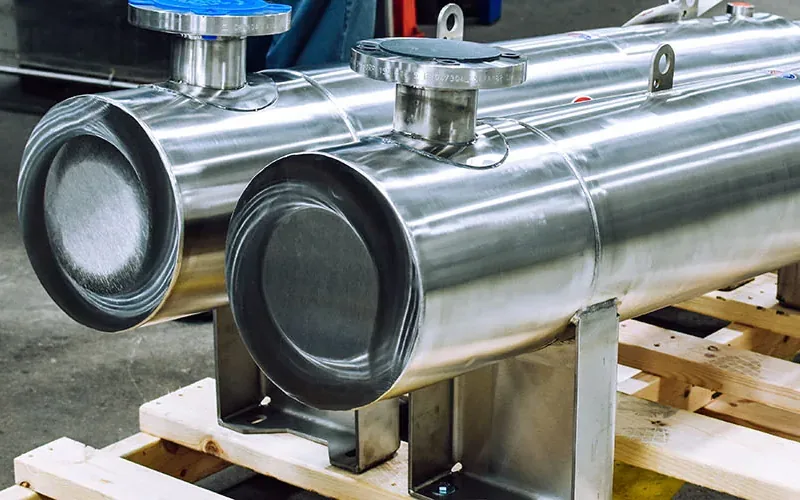
Sanitary shell-and-tube heat exchangers in 304L and 316L for food, dairy and pharma: product in the tubes, drainable, polished, built to 3-A when needed.
+ Learn More
Sanitary Applications
Dairy
Dairy heat exchangers that can be built to 3-A standard 12-08: CIP heaters, pasteurizing heaters and product coolers, with stock units ready to ship.
+ Learn More
Sanitary Applications
Food & Beverage
Food and beverage heat exchangers for wort, juices, syrups, sauces and chocolate: sanitary shell and tube units, bayonet tank heaters and CIP heaters.
+ Learn More