
1-805-484-2992
Quotes - Engineering - SalesFind your industry
The starting point for anything people eat, drink or put on their skin: 304L or 316L, product in the tubes, polished contact surfaces and units that can be built to 3-A.
Pasteurizing, cooling cream, heating whey protein concentrate and ice cream mix, and the CIP heater that cleans all of it. Dairy QA asks about drainability and finish before it asks about price. Whey, yogurt and liquid egg each bring their own fouling pattern and temperature limit.
Syrups, sauces, juices and brewing, from wort heating and cooling to the cleaning loop behind the brewhouse. Viscosity and particle size settle the tube diameter more often than flow does.
The heater behind every cleaning cycle: steam or hot water on the shell, caustic and acid solution in the tubes, and a sanitary build that matches the lines it cleans.
Lotions, creams, shampoos and pet food. Thick, shear-sensitive products want gentle velocities and a sanitary finish wherever the product touches metal.
Seamless 316L tubes polished to 25 Ra or better, double tubesheets with leak detection, shells pitched to drain both sides, and cGMP practice from cutting to final passivation.
Point-of-use coolers, loop heaters and pure steam condensers for WFI systems. Leading WFI system suppliers worldwide build these exchangers into their skids.
Ethanol chilled to subzero temperatures, evaporators for solvent recovery and condensers that bring the ethanol back, in 32 Ra food grade stainless at a minimum.
Reboilers, process heaters and condensers for refineries, renewable fuel plants and tank terminals, in carbon steel through high alloy, to TEMA R where the service calls for it.
Carbon steel units are built in Beggs, Oklahoma, away from the stainless-only shop in Medford, Wisconsin.
Mounted at the tank outlet, a suction heater warms the heavy oil or molasses being drawn off and leaves the rest of the tank alone, which saves steam on large storage.
The same shell-and-tube designs serve very different plants. What changes is the finish, the code stamp and which fluid runs in the tubes. Open the market closest to yours.
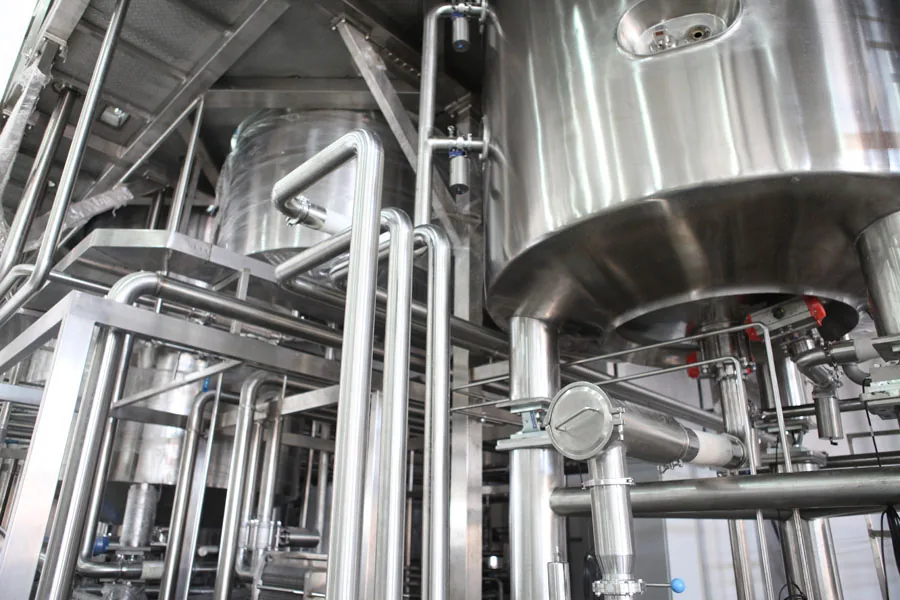




What changes from market to market
A dairy heater and a refinery reboiler can start from similar drawings. These four details are what set them apart.
Surface finish
3-A units carry 32 Ra or better on product contact. Pharma units start at 25 Ra, and electropolishing reaches 15 Ra. Industrial service rarely needs a polish at all.
Which side the product runs
Sanitary duties put the product in the tubes, where it can be cleaned and inspected. In straight-tube units, industrial duties often send the dirtier or higher pressure fluid there instead. U-tube units reverse that: the dirty fluid runs outside the tubes, on a bundle that pulls out for washing.
Codes the buyer asks for
- 3-A for dairy and food
- ASME-BPE practice and cGMP for pharma
- TEMA R for refinery service
- PED and CRN for export
Material
304L covers most food work and 316L the chloride and pharma duties. Duplex, Hastelloy, AL-6XN and titanium take over where stainless would pit or crack. Carbon steel handles clean hydrocarbons, thermal oil and steam, where a corrosion allowance is enough.
Busiest markets
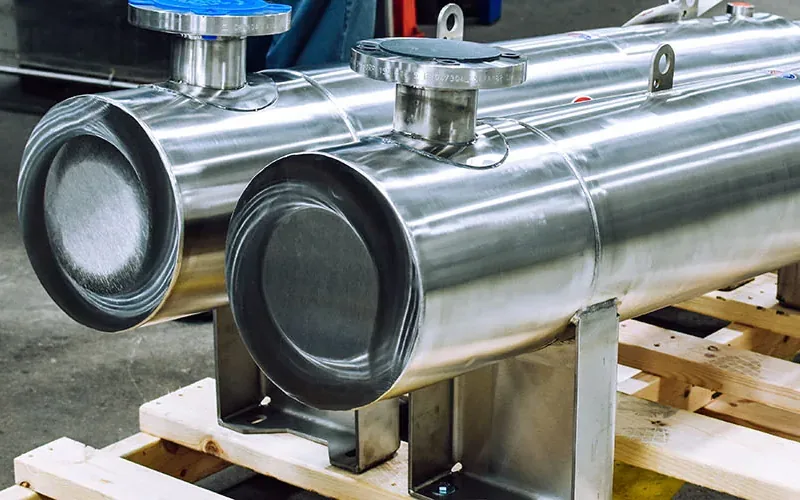
Sanitary Applications
Sanitary Shell & Tube
Sanitary shell-and-tube heat exchangers in 304L and 316L for food, dairy and pharma: product in the tubes, drainable, polished, built to 3-A when needed.
+ Learn More
Process Applications
Pharmaceutical
Pharmaceutical shell and tube heat exchangers for WFI, CIP and bioprocess duties: 316L tubes at 25 Ra or better, electropolish and double tubesheets.
+ Learn More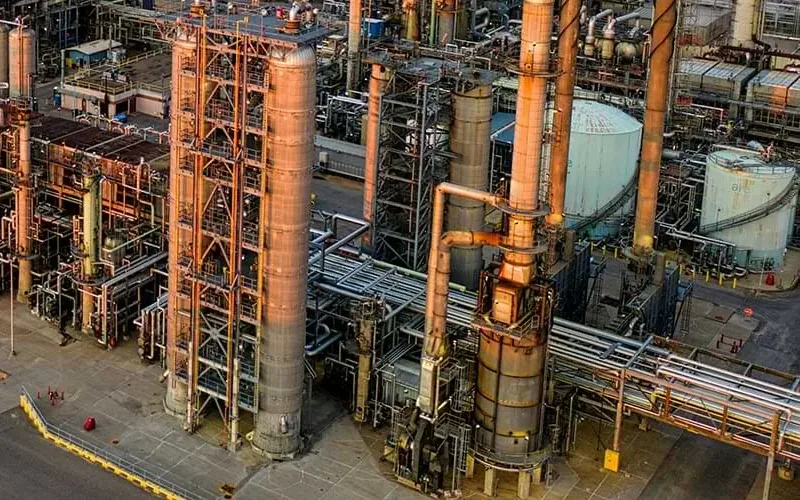
Process Applications
Refining
Refining heat exchangers and refinery shell and tube units: reboilers, condensers, coolers and tank heaters built to TEMA R and ASME, API-660 on request.
+ Learn More