
1-805-484-2992
Quotes - Engineering - SalesHeat applied at the tank outlet, where product leaves
When a heavy product will not flow to the pump, the heat can go at the tank's outlet nozzle. A suction heater bolts there: its shell, or shroud, reaches into the tank with an open end, and a U-tube bundle inside it carries steam or hot oil. When the pump draws product out, the liquid enters the open end, flows across the heated tubes and leaves through the flanged outlet warm enough to move. Everything else in the tank stays at storage temperature. The bundle and its tubesheet bolt to a flange on the outside of the heater, so the heating element comes out without anyone entering the tank.
It is the right tool for heavy products that are stored cool and only need to flow on their way to the pump: heavy fuel oil, molasses, tallow, wax and viscous chemicals at tank terminals, refineries and chemical plants. Holding a large heavy oil tank at pumping temperature around the clock spends steam on the whole inventory, plus everything lost through the tank walls and roof. A suction heater spends its energy only on the product that actually leaves, and only while the pump is running.
The tank still has to deliver product to the heater. If the bulk cools so far that it will not run into the open end, or sets up on the floor around the shroud, the heater starves. Some tanks therefore pair it with a small holding coil that keeps a pool of liquid around the outlet while the suction heater does the main work during pump-out. A tank whose entire contents must stay warm, to stop skinning, settling or crystallizing, needs whole-tank heat instead, which is the job of a bayonet immersion heater or tank coils.
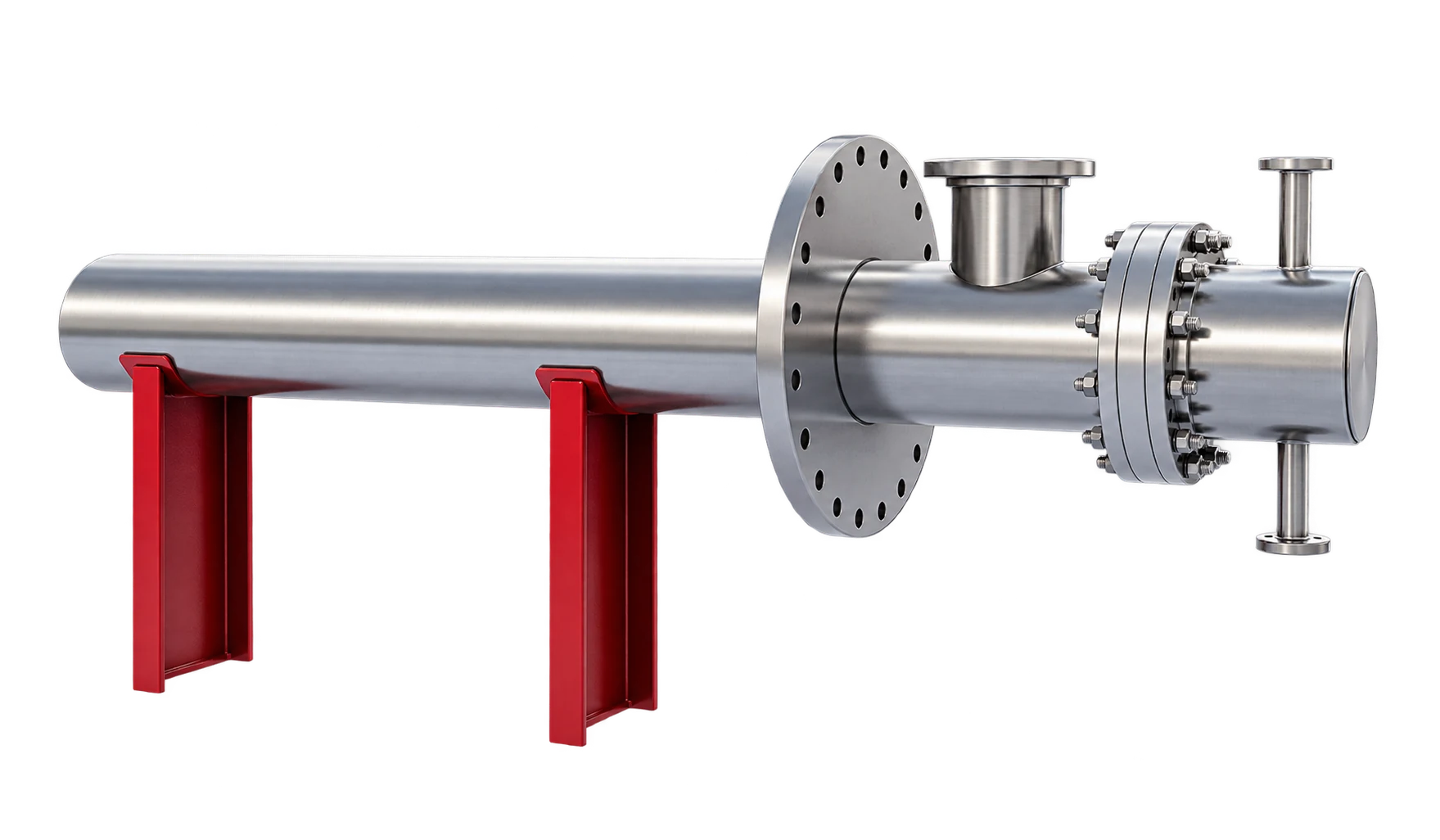
Heating a whole storage tank so that part of it can be pumped out is the expensive way; a suction heater warms only the stream on its way to the pump.
Energy goes into product that is leaving, only while the pump runs.
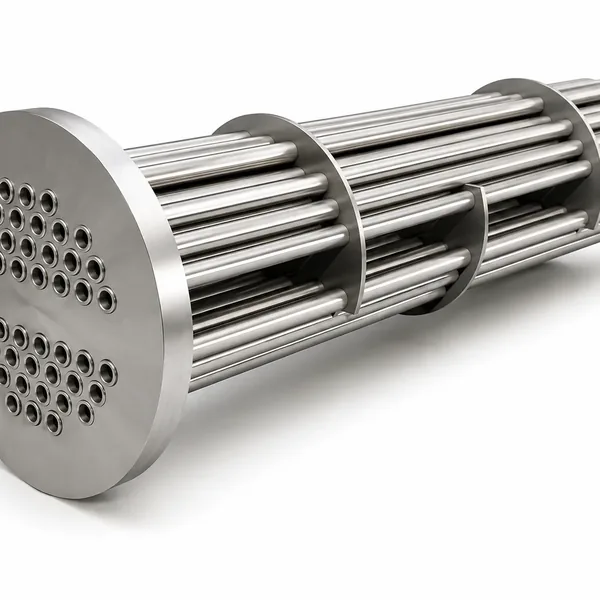
Bundle out without entering the tank
- U-tube bundle bolts to the heater's outer flange
- Tubes grow freely around the bends every cycle
- Steam, hot water or hot oil inside the tubes
- Bundle cleaned or inspected on the ground
- A spare bundle shortens a planned outage
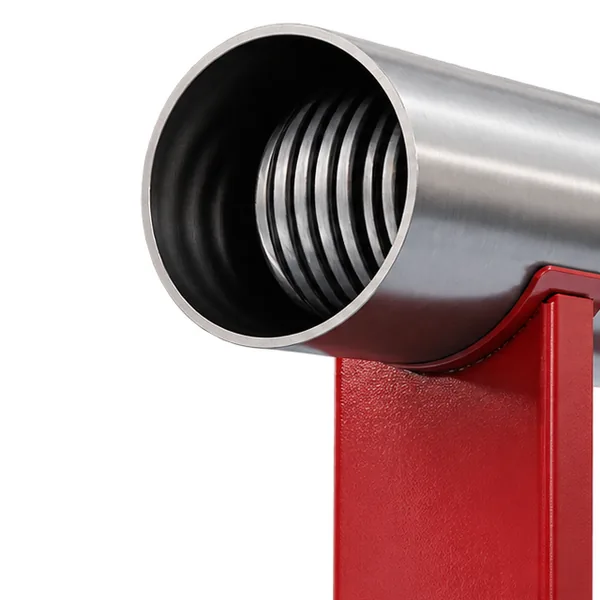
Heat follows the pumping flow
- Open shroud end draws product across the tubes
- Heat applied only while product is pumped out
- Bundle length set by the pump-out rate
- Carbon steel units built in Beggs, Oklahoma
- Stainless and alloys for corrosive chemicals
Suction Heater Basics


Suction Heater Construction
Each suction heater is designed to its tank nozzle, its product and the pump-out rate it must keep up with. This table lists the parts and choices that make up a unit.
| Item | Detail |
| Arrangement | Shell or shroud open inside the tank, flanged outlet outside |
| Heating element | Removable U-tube bundle on a bolted tubesheet |
| Heating media | Steam, hot water or hot oil in the tubes |
| Products | Heavy fuel oil, molasses, tallow, wax, viscous chemicals |
| Materials | Carbon steel, 304L and 316L stainless; higher alloys for corrosive service |
| Where built | Carbon steel in Beggs, Oklahoma; stainless and alloy in Medford, Wisconsin |
| Connections | ASME / ANSI flanged or NPT threaded |
| Code | Designed to ASME Section VIII; code stamp and witnessed hydro-test available |
| Options | Thermowells and non-asbestos, chloride-free insulation |
Sizing and Fitting a Suction Heater
Suction heater or whole-tank heating
Ask what has to be warm, and when. If only the product in the transfer line needs to flow, and only while a truck, railcar or vessel is loading, a suction heater does the job on far less energy. If the bulk must stay above a set temperature at all times, because the product skins, settles or sticks to the walls, the tank needs heat of its own, and a suction heater may still sit at the outlet to finish the job. Mixed duty is common at terminals: a modest holding load on the tank and a larger pumping load at the outlet.
The numbers that size it
The pump-out rate sets the load, and viscosity sets the target. The heater has to raise the full pumping flow from storage temperature to a temperature the pump and line can handle, in one pass across the bundle. That target comes from the product's viscosity curve, so a viscosity-versus-temperature chart, or at least two viscosity points, is worth more than a product name. Heavy products thin sharply as they warm; overshoot the target and heat is wasted, fall short and the pump cavitates or the transfer drags.
- Pump-out rate and how long each transfer runs
- Storage temperature and the pumping temperature you need
- Viscosity at two or more temperatures, or the full curve
- Heating medium and its supply pressure or temperature
- Outlet nozzle size and rating, and the clear depth inside the tank
Steam or hot oil in the tubes
Steam is the usual medium where a plant has it. It condenses at a fixed temperature set by its pressure, and the U-bends let the tubes grow as they heat. Condensate must leave the bonnet freely through a trap, or the lower tubes flood and lose surface. Hot oil reaches higher temperatures at low pressure, which suits the heaviest oils, and its supply temperature can be trimmed for smoother control; Enerquip also builds the thermal fluid heaters that supply it. Avoid a medium so hot that the product film on the tubes chars, because that layer insulates the bundle and is hard to remove.
Materials, code and installation
Carbon steel is the normal choice for fuel oil and most hydrocarbons, and Enerquip's carbon steel work is done in Beggs, Oklahoma. Molasses, tallow and edible fats often call for 304L or 316L, and corrosive chemicals may need duplex or a higher alloy. Units are designed to ASME Section VIII and hydro-tested. Keep the ground beyond the heater flange free of pipe racks and walkways for a full bundle length. Pulling the bundle opens the heater to the tank, so schedule it with the level brought down below the outlet.
Call and talk it through with an engineer: 1-805-484-2992
Running and fitting suction heaters
Cut back the heating medium. Product trapped in the shroud keeps soaking heat from the tubes with nothing carrying it away, and an overheated film can char on the bundle. Most installations tie the steam or hot oil valve to the pump. On restart, give the heater a short warm-up before pulling full flow, especially after the tank has cooled overnight.
It can, provided the tank has an outlet nozzle of a usable size and rating, and room inside for the shroud to reach in without meeting the floor, a coil or a mixer. Send the nozzle data, a tank drawing or photos, and the product. The heater is built to bolt onto that nozzle, so the tank itself is not altered.
The likely cause is a long, bare line between heater and pump, where the product cools again before it arrives, or the heater was sized for a lower pump-out rate than the one running today. Insulate and trace the line, then compare today's flow with the design rate. A fouled bundle gives the same symptom, showing up as an outlet temperature that falls slowly over months.
Related

Process Applications
Pharmaceutical
Pharmaceutical shell and tube heat exchangers for WFI, CIP and bioprocess duties: 316L tubes at 25 Ra or better, electropolish and double tubesheets.
+ Learn More
Process Applications
WFI Exchangers
WFI heat exchangers for water-for-injection and purified water loops: point-of-use coolers, loop heaters and pure steam condensers in polished 316L.
+ Learn More
Process Applications
Cannabis Extraction
Cannabis extraction heat exchangers: subzero ethanol chillers, solvent recovery condensers, evaporators and product coolers in sanitary stainless steel.
+ Learn More