
1-805-484-2992
Quotes - Engineering - SalesStraight tubes you can see daylight through
When the tube-side fluid leaves deposits that only a rod or brush will shift, the tubes need to run straight, and a fixed tubesheet exchanger runs them between two tubesheets welded to the shell at both ends. A head bolts to each tubesheet, so taking one off exposes a full face of tube ends, and with both off you can look down any bore and see light at the far end. Shell and bundle are one assembly; nothing slides and nothing seals on packing. Enerquip builds stainless and alloy units in Medford, Wisconsin and carbon steel units in Beggs, Oklahoma, single or multi-pass, with sanitary tri-clamp ends or ASME flanges.
A rod, brush or hydroblast lance travels straight through each tube, and a tube that fails can be pulled and replaced or plugged at both ends. It is also the least expensive shell-and-tube per square foot: the tubes need no bending, there is no floating joint, and the bundle fills the shell with little bypass clearance, so more tubes fit in a given diameter. Clean shell-side fluids such as steam, treated water and glycol suit it well.
The shell side cannot be opened. With the bundle welded in place, the outside of the tubes is reachable only by chemical cleaning, so a scaling or dirty fluid does not belong there. The second limit is thermal growth. Shell and tubes are tied together at both ends, so when one runs much hotter than the other, the difference in expansion pulls at the tube joints and tubesheets. Past a modest temperature difference the shell needs an expansion joint; past what a joint handles comfortably, a U-tube or floating tubesheet design is the better call.
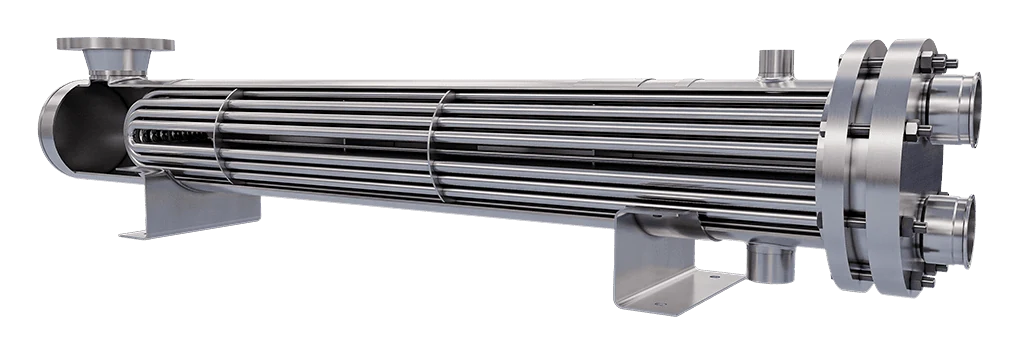
Every tube in a fixed tubesheet unit is a straight line from head to head, so the tube side can be rodded, inspected and retubed one tube at a time.
Keep the shell side clean and watch the temperature gap.
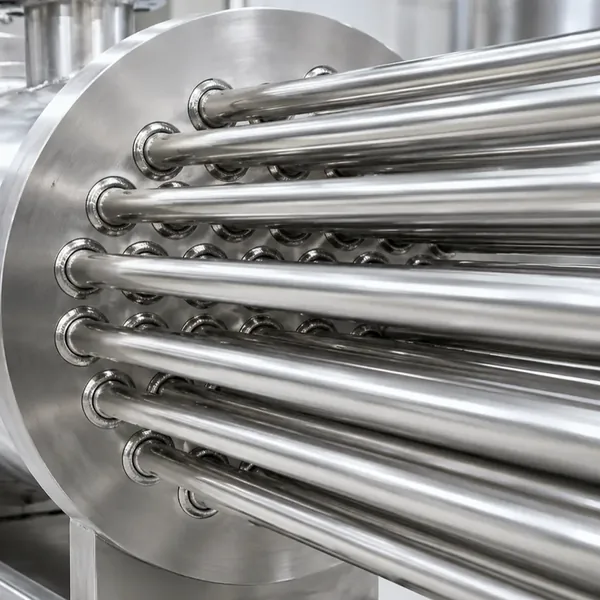
Tube side cleaned end to end
- Rod, brush or hydroblast each tube straight through
- Look down any bore once both heads are off
- Failed tubes replaced or plugged one at a time
- Single-pass or multi-pass set by head partitions
- Twisted tape turbulators for slow tube-side flow
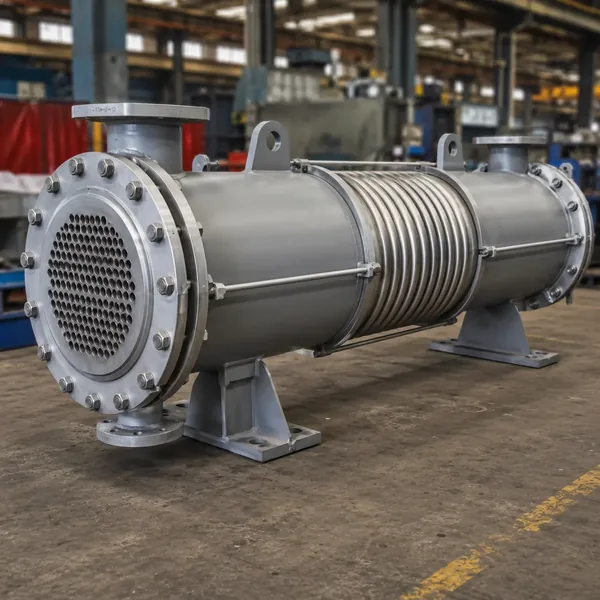
Handles growth, keeps fluids apart
- Shell expansion joint for a wider temperature gap
- Double tubesheet with leak detection on request
- Tri-clamp product ends on sanitary straight-tube units
- ASME flanged or lap joint ends for process piping
- Weep slots in pass partitions so the tubes drain
Fixed Tube Essentials


Fixed Tubesheet Build Options
Fixed tubesheet units are built to the duty rather then pulled from a shelf. These are the choices that define one, from the pass arrangement to the code stamp.
| Feature | Detail |
| Construction | Straight tubes between two tubesheets welded to the shell |
| Tube passes | Single-pass or multi-pass |
| Thermal growth | Shell expansion joint where shell and tube temperatures differ widely |
| Tubesheets | Single, or double tubesheet with leak detection |
| Shell diameter | To 48", larger depending on weight |
| Materials | 304L and 316L stainless, carbon steel, duplex 2205 and 2507, Hastelloy, Alloy 20, Monel, AL-6XN, titanium Gr 2 |
| Connections | Sanitary tri-clamp, ASME / ANSI flanged, lap joint, NPT threaded |
| Codes | ASME Section VIII stamp; TEMA B, C or R; 3-A, PED, CRN |
| Finishes | Passivated in-house; electropolish to 15 Ra |
When Fixed Tubesheet Construction Is the Right Call
The TEMA types in plain words
The last letter tells you the tubesheet is fixed. A BEM has bonnets at both ends and a one-pass shell; it is the simplest arrangement and usually the least expensive. An AEL puts a channel with a removable cover at the front, so the tube ends can be reached without breaking the nozzle piping. An NEN makes the channel integral with the tubesheet, which suits high tube-side pressure. All three share the same limits: straight tubes, a shell side that stays closed, and a temperature difference the shell has to absorb.
Expansion joints and the temperature gap
High-pressure steam on the shell and a cold liquid in the tubes is the classic case that cracks a fixed tubesheet unit built without a joint. The tubes stay near the product temperature, the shell near the steam temperature, and every heat-up pulls the two against each other. A bellows or flanged-and-flued expansion joint in the shell lets it grow on its own. The design calculation decides whether one is needed, from the metal temperatures at startup, upset and normal running. Checking only steady state is how a unit ends up with leaking tube joints after a season of cold starts.
When to choose U-tube or floating
Fixed tubesheet construction is a poor fit in a few predictable cases. If one of them describes your duty, a U-tube bundle or a floating tubesheet will cost less over its life, even when it costs more to buy.
- Shell-side fluid that scales, fouls or carries solids and must be washed off
- A temperature difference too large for an expansion joint to take comfortably
- Frequent thermal cycling, where joint fatigue would set the service life
- A plant that wants to swap a bundle rather than replace the exchanger
Sanitary straight-tube units
Straight tubes are the sanitary answer for product that bakes on. With tri-clamp ends and removable bonnets, each 316L tube can be swabbed, borescoped or brushed end to end, which matters to a QA auditor on a product that leaves residue. Enerquip pitches pharmaceutical units to drain on both sides, cuts weep slots in the pass partitions and fully radiuses the return pockets. On WFI and purified water, a double tubesheet at each end adds a vented gap, so a leaking joint shows outside the unit instead of reaching the water. Send the duty, the drawing or the U-1, and we will match it.
Call and talk it through with an engineer: 1-805-484-2992
Buying a straight-tube unit
Yes, and it is one of this design's real advantages. The heads come off, the failed tube is cut free at both tubesheets and drawn out through one end, and a new tube is rolled or welded in. When time is short, plugging both ends is faster and costs only that tube's surface. Keep a count; a rising number of plugs usually points to corrosion or erosion worth solving before retubing.
The metal temperatures decide it, and they can differ from the fluid temperatures. The design calculation compares how far the shell and tubes grow at startup, normal running and upset, and the stress that puts on the tubesheets and tube joints. Send the worst case you expect, such as a cold start or a loss of flow on one side, because that is usually the condition that decides it.
Single-pass gives true counterflow and the lowest pressure drop, which suits a large flow with a small temperature change. Multi-pass divides the tubes with partitions in the heads, so the fluid runs the length of the shell several times, raising velocity and heat transfer when the flow is small. Each added pass costs pressure drop, so the allowable tube-side drop usually sets the limit.
Only chemically. The bundle never leaves the shell, so the outside of the tubes is cleaned by circulating a solution chosen for the deposit. That works on light films. A fluid that lays down hard scale or sludge on the shell side will slowly choke the unit, and it should be moved to the tubes or given a removable bundle.
Yes, when the design calls for it. Product runs through 316L SA-213 seamless tubes finished to 32 Ra or better, and the gasket design is exposed so cleaning solution reaches it. Raise 3-A at the quote stage; adding it after the drawing is approved changes the tubing order, the head design and the documentation package.
Related
Heat Exchangers
Immersion Heaters
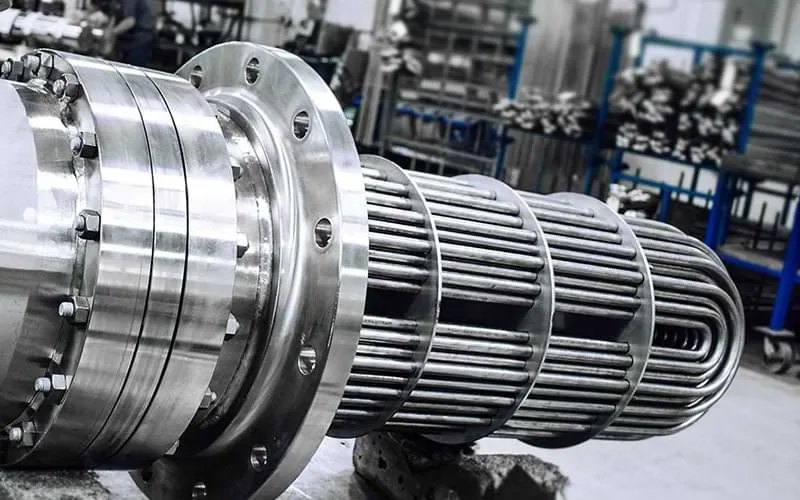
Enerquip bayonet immersion heaters warm a whole tank through a flange or manway it already has, with a removable bare or finned tube bundle.
+ Learn More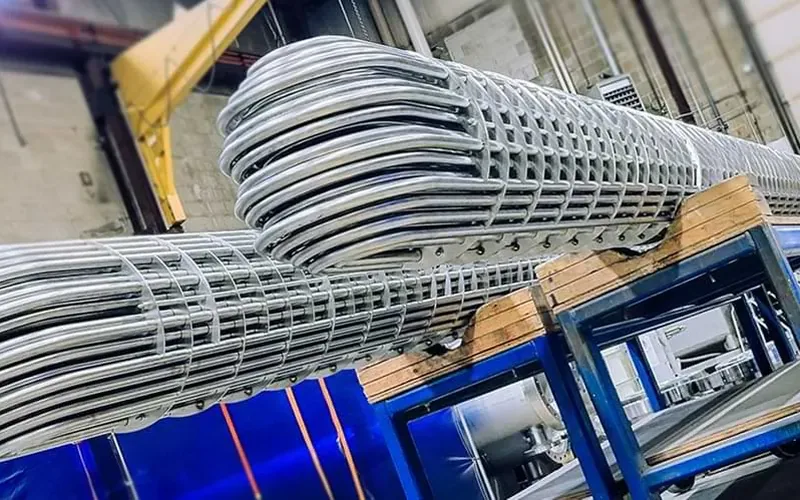
Heat Exchangers
Replacement Bundles
Replacement tube bundles, O-rings and gaskets for Enerquip exchangers, plus drop-in bundles built to your shell from a nameplate, drawing or U-1.
+ Learn More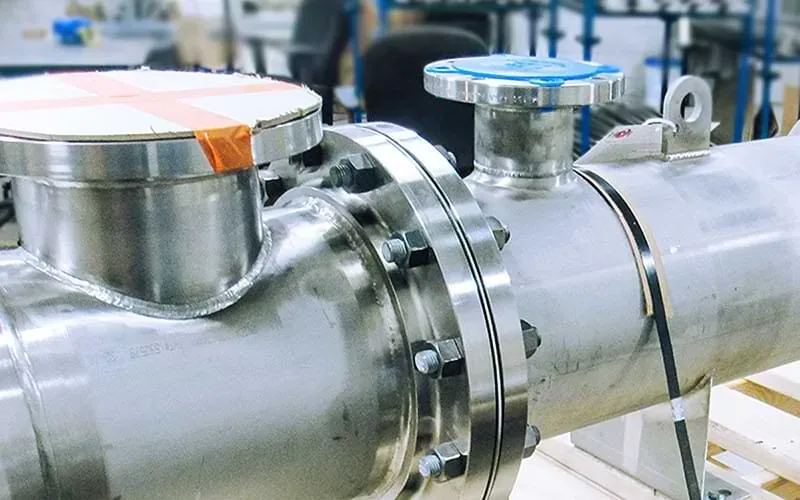
Heat Exchangers
Industrial Shell & Tube
Custom industrial shell-and-tube heat exchangers in stainless, carbon steel and high alloys to 48" diameter, built to TEMA B, C or R and ASME stamped.
+ Learn More