
1-805-484-2992
Quotes - Engineering - SalesHeat exchangers that serve the water loop
Point-of-use coolers, loop heaters and pure steam condensers
Water for injection runs around the clock as a plant utility, and its heat exchangers work to a different rhythm from process equipment. Water is generated, stored, circulated past every use point and returned to the tank. None of these exchangers handles product, but each touches water that ends up in product.
Purified water loops follow the same pattern to a lower specification, and many plants run both. Enerquip builds sanitary coolers that drop hot loop water for a use point, heaters that hold loop temperature and carry hot sanitization, and condensers for pure steam.
Leading WFI system suppliers worldwide have standardized on Enerquip exchangers, so the cooler on an existing skid may already be one. When a plant adds a drop or replaces a cooler, we can match the new unit to the existing nameplate or drawing.
Request a Quote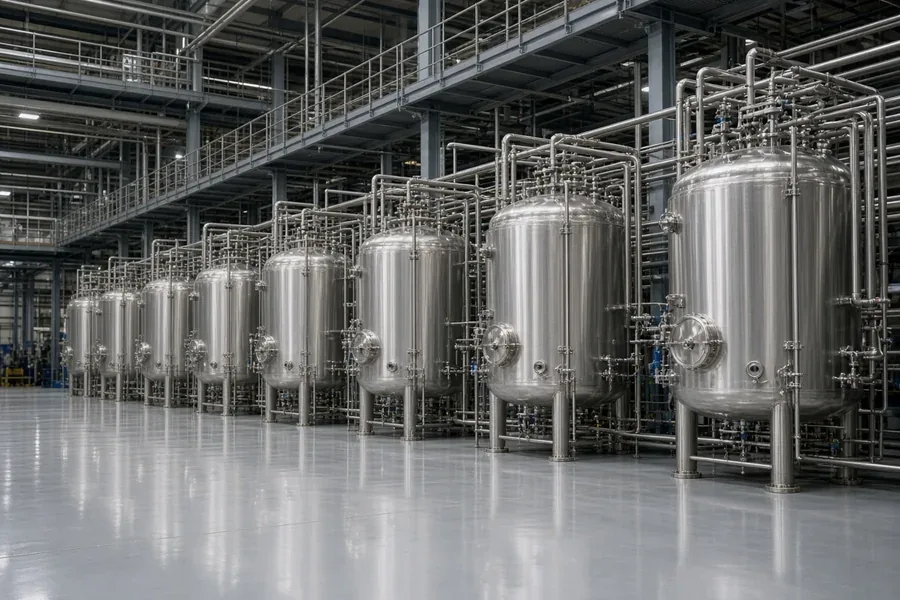
In WFI service the leak path matters more than the duty
A point-of-use cooler puts plant cooling water one tube wall away from WFI. A double tubesheet sends a failed joint to atmosphere instead, and 316L tubes at 25 Ra or better keep the water side clean.
Sized for the loop and the drop
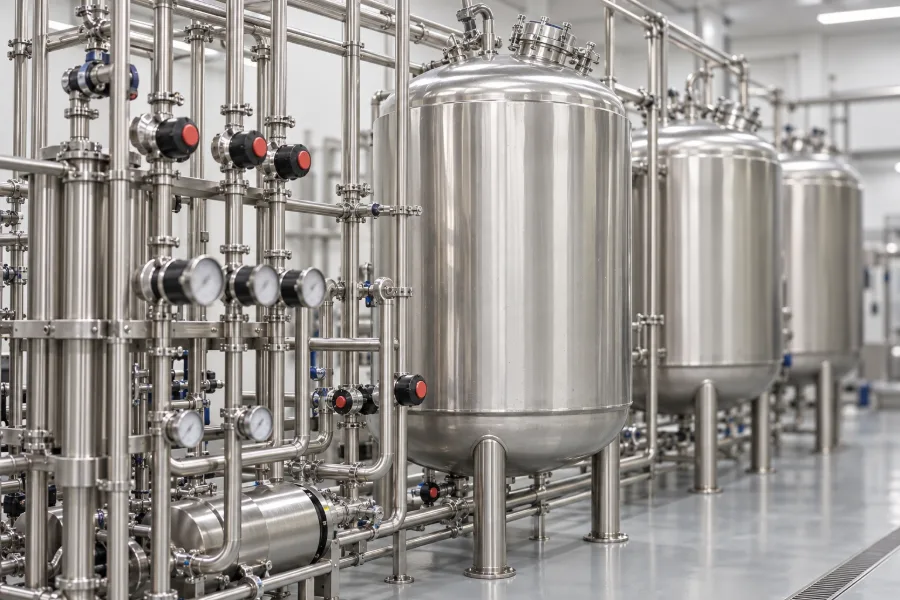
- Coolers sized to each use point's demand
- Loop heaters for temperature and sanitizing
- Pure steam condensers, tube-side condensing
- Tri-clamp ends to ASME-BPE dimensions
- Vertical or pitched mounting to drain fully
Two tubesheets, one leak path
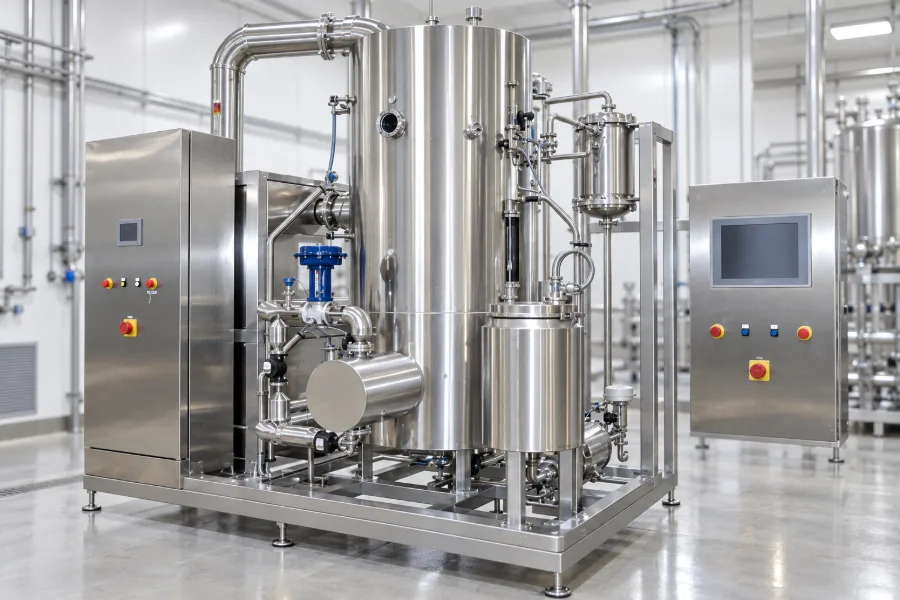
- Vented gap between the inner and outer sheet
- Leak detection at the interspace
- 316L seamless tubes, 25 Ra or better
- Electropolished to 15 Ra where specified
Matching the exchanger to the WFI or PW duty
Five places an exchanger sits in a pharmaceutical water system, and the construction we would quote for each. Where water quality is at stake, the double tubesheet is the default.
| DUTY | EQUIPMENT | WHY IT FITS |
| Point-of-use cooling | Double tubesheet sanitary cooler | Cools hot loop water for one user while any joint leak vents between the sheets |
| Loop heating and sanitizing | Sanitary U-tube heater | Steam on the shell holds the loop, free U-bends absorb each heat-up, and a double tubesheet guards against plant steam |
| Pure steam condensing | Pharmaceutical vapor condenser | Steam condenses inside polished tubes, so the sample stays as clean as the steam |
| Ambient PW loop trim cooling | Straight-tube sanitary cooler | Removes pump heat from a cold loop; each straight tube can be inspected end to end |
| Failed cooler on a skid | Matched replacement bundle | Built to the existing shell and nozzle dimensions, so the skid piping stays as validated |
How a point-of-use cooler is designed and run
The cooler spends more time idle than cooling. A use point may draw water for an hour and then sit for a shift. When the draw stops, the cooled section becomes a dead leg unless it is drained, flushed back to the loop or returned to loop temperature. Most designs run a sanitization sequence: shut off the coolant, let hot loop water pass through the tubes until the whole cooler is back at loop temperature, then hold it there until the next draw.
That sequence puts the exchanger through a thermal swing on every cycle: the tube side goes from cool to hot and back, often several times a day, while the shell goes from full coolant flow to stagnant. With a double tubesheet, the two sheets see different fluids and temperatures, so the short tube span between them flexes on every cycle; ask how the tube ends are made. Enerquip roller expands each tube into double-grooved tubesheets, then seal welds it.
The coolant is the contamination risk. Plant cooling water and glycol carry treatment chemicals, corrosion products and bacteria that have no place in WFI. With a single tubesheet, a cracked joint lets that fluid cross whenever it's pressure exceeds the WFI side, and the only defense is holding WFI pressure higher at every moment, including during sanitization and pump trips. A double tubesheet takes pressure out of the argument: the fluids are separated at each tube end by a vented gap.
Loop heaters see the widest swing in the system. On a purified water loop, or a WFI loop not generated hot, a heater on the return or the tank holds temperature and runs the periodic hot sanitization. Give us both ends of that cycle and the time allowed to reach temperature. The double tubesheet logic applies whenever the heating medium is plant steam rather than clean steam.
Finish, drainage, steam and paperwork
Electropolish against rouge
Passivation and electropolishing are done in-house in Medford, Wisconsin. Water-side tubes start as 316L seamless polished to 25 Ra or better, and electropolishing can take contact surfaces to 15 Ra. In a hot water loop the practical gain is resistance to rouge: a smoother, chromium-rich surface gives the iron oxide film less to grow on, so the system can run longer between derouging. Specify the finish for the water side; the coolant side rarely needs it.
Drainability is proven on the skid
Water systems are tested for drainability, and the exchanger is part of that test. Units come on vertical supports or pitched horizontal saddles, with weep slots in the pass partitions and radiused return pockets so the channel empties between passes. A very smooth tube can still hold a film that clean air or a heat cycle clears. The slope only drains if the skid frame keeps it.
Condensers for pure steam
Pure steam is sampled and tested like the water it is made from, so a condenser on a sample point must not add anything to it. Enerquip pharmaceutical condensers put the condensing steam in the tubes, use tri-clamp connections to ASME-BPE dimensions, come in 316L or Hastelloy, and are often electropolished to about 20 Ra. A double tubesheet can be added where plant water cools the shell.
What goes in the turnover file
A water system file usually asks for more than the material traceability and ASME U-1 data report a stamped vessel carries. List every document your validation protocol references on the request for quote, such as surface finish, passivation or electropolish records and the drainability check, so the package is assembled while the unit is built rather than reconstructed afterward. cGMP practices apply to pharmaceutical orders.
Point-of-use cooler questions
Not always. It is the standard choice wherever plant cooling water, glycol or plant steam sits across the tube wall from WFI. Where both sides carry clean fluids, such as a clean steam heater on a WFI loop, a single tubesheet with seal-welded joints may satisfy your quality group. Settle it with them before the quote, since a second sheet changes the length, weight and price of the unit.
The gap between the two sheets is open to atmosphere through a detection port or a visible drain. A failed joint on either sheet leaks into that space and shows as liquid at the port instead of crossing to the other side. Put the port where an operator walks past it; a port buried behind insulation tells nobody anything.
It can, but it is rarely the better design. Two users with different draw rates and schedules leave a shared cooler running far from its design flow much of the time, which hurts temperature control and lengthens the sanitize sequence. Separate coolers are simpler to control and validate, and one drop can come out of service alone.
That depends on the coolant more than the exchanger. Plant cooling water can bring WFI down to a little above its own supply temperature; colder targets need chilled water or glycol on the shell, planned around a coolant rise of about 10 F. Give us the loop temperature, the target at the user, the draw rate and the coolant available, and we will size the cooler and tell you whether that coolant can reach the target.
Related
Process Applications
Cannabis Extraction
Cannabis extraction heat exchangers: subzero ethanol chillers, solvent recovery condensers, evaporators and product coolers in sanitary stainless steel.
+ Learn More
Process Applications
Refining
Refining heat exchangers and refinery shell and tube units: reboilers, condensers, coolers and tank heaters built to TEMA R and ASME, API-660 on request.
+ Learn More
Process Applications
Suction Heaters
Enerquip tank suction heaters warm only the product leaving the tank - heavy fuel oil, molasses, tallow, wax - with a removable steam or hot-oil bundle.
+ Learn More