
1-805-484-2992
Quotes - Engineering - SalesEquipment that passes the validation file
WFI, CIP, sterilizing solutions, bioreactors and vaccine production
Two groups sign off on every exchanger in a pharmaceutical plant. The process engineer judges it on duty: does the WFI loop hold temperature, does the cooler at each use point deliver water where it should, does the CIP heater recover between cycles. The quality group judges it on paper: material certificates, inspection and test records, weld documentation and a drainability case that holds up in an audit. Enerquip builds for both readers.
The duties span the plant: heating and cooling sterilizing solutions, conditioning media for bioreactors, controlling temperature through vaccine production, and supporting cryopreservation steps where biological material is chilled for storage. The leading CIP and WFI system suppliers worldwide have standardized on Enerquip exchangers, so many of these units arrive already built into a skid, and the same design can be ordered alone as a spare.
Request a Quote
In WFI service, a unit that cannot drain cannot be validated
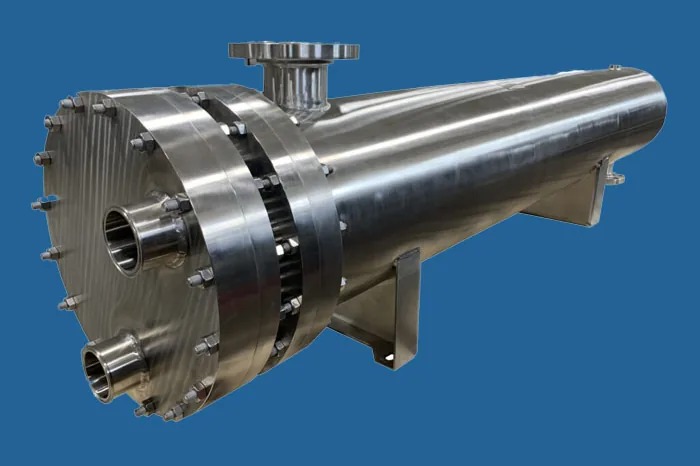
Pharma exchangers use 316L seamless tubes polished to 25 Ra or better and are pitched so both sides drain by gravity; highly polished tubes may still need air or heat to clear the last film.
Finished inside and out
- 316L seamless tubes polished to 25 Ra or better
- Electropolished finishes down to 15 Ra
- Exterior and jackets polished to 40 Ra
- In-house passivation before shipment
- Condensers and evaporators often 20 Ra EP
Built for sterile and water duties
- Double tubesheet with a leak detection gap
- Pitched to drain on both shell and tube side
- Tri-clamp connections to ASME-BPE
- Full material traceability in the file
Pharma duties and the Enerquip unit for each
Four duties account for most pharmaceutical requests, each shown with the equipment we would quote first and the detail that makes it fit.
| DUTY | EQUIPMENT | WHY IT FITS |
| WFI point-of-use cooling | Double tubesheet sanitary unit | A failed tube joint vents to atmosphere between the sheets instead of reaching the WFI side |
| CIP and sterilizing solutions | 316L sanitary heater | Built to the finish of the system it cleans, with product in tubes pitched to drain |
| Solvent and vent condensing | Pharmaceutical vapor condenser | Tube-side condensing, tri-clamp ends, single or double tubesheet, 316L or Hastelloy, electropolished |
| Spare bundle for a skid | Replacement tube bundle | Keeps a validated shell in service; built to the dimensions of the original bundle |
How Enerquip builds a pharma-grade exchanger
The tube joint is where contamination starts. Enerquip uses 316L seamless tubes, polished to 25 Ra or better, and roller expands each one into a double-grooved tubesheet before seal welding it. The expansion gives the joint its mechanical strength; the seal weld closes the crevice that a rolled joint alone would leave for product to collect in. Auditors tend to ask about this detail first.
The drain path belongs on the drawing. Both the shell and tube sides are pitched to empty by gravity. Weep slots in the pass partitions let the channel drain between passes, and the return pockets and weep slots are fully radiused and polished so nothing hangs up in a corner. The result is a unit whose drain path can be traced on the drawing and demonstrated on the floor.
Finish is controlled in-house. Passivation and electropolishing are done in Medford, Wisconsin, which keeps cost, quality and lead time under one roof, and electropolished surfaces reach 15 Ra where the specification calls for it. The exterior and insulation jackets are polished to 40 Ra as standard, so the unit wipes down like the rest of the suite.
Behind the hardware sit the paperwork and the practice. Enerquip engineers take part in ASME-BPE committee work on hygienic design and fabrication, the shop follows cGMP practices on pharmaceutical orders, and full material traceability goes with every unit. In-process inspection and testing run through the build rather than arriving as a check at the end, so the documents your validation team receives match what was actually made.
Options for critical service
Double tubesheet with leak detection
Where a shell-to-tube leak would put a utility into product, a double tubesheet adds a second sheet and a small gap at each tube end. A tube joint that fails leaks into that gap and shows up at the detection port instead of crossing to the clean side. The gap is vented, so a leak cannot build pressure there. It costs more than a single tubesheet and earns it on WFI and sterile duties.
Insulation that stays clean
Hot WFI and CIP units are usually insulated, and in a classified area the covering must wipe down like the room around it. The option here is a Thermalux moisture barrier over non-asbestos, chloride-free Inswool ceramic insulation, covered by polished pipe jackets fully welded and finished to 40 Ra. Nozzle covers can be stainless sheet tack welded in place or PipeTite boots. The industrial heat exchanger page explains why chloride-free insulation matters.
Process duties in a sterile suite
Point-of-use coolers, loop heaters and pure steam condensers are covered on the WFI heat exchangers page. On the process side, the same questions come up for bioreactor media heaters, sterilizing solution coolers and vaccine production steps: which fluid sits across the tube wall from product, whether a failed joint could let it through, and how the unit drains between batches. Where a plant utility sits next to product, the double tubesheet earns its place too.
Material choices beyond 316L
316L covers most pharmaceutical service. Where a solvent, a chloride-bearing solution or an aggressive cleaning agent calls for more, the line also builds in Hastelloy, AL-6XN, duplex stainless and titanium. Whatever the alloy, the product side carries the same finish, drainability and traceability requirements as a 316L unit, so name the alloy and the finish together on the request. Cost-saving construction for high alloy units is covered on that page as well.
Validating a pharma exchanger
Full material traceability, the ASME U-1 data report for the stamped vessel, and the inspection and test records your specification calls for. Tell us at the quote stage what the turnover package must contain, because adding a document after fabrication is far harder than planning for it.
25 Ra or better on 316L tubes is the standard pharmaceutical finish and suits most WFI and CIP duties. Electropolishing goes further, down to 15 Ra, and removes the peaks a mechanical polish leaves behind, which helps where product adhesion or rouge is a concern. Applying it everywhere raises cost without changing the duty.
Surface tension holds a film on very smooth tubes even when the unit is pitched correctly, and clean compressed air or a heat cycle finishes the job. If drain checks keep failing, measure the pitch as installed before blaming the unit. An exchanger shimmed level on the skid will not drain the way it was drawn.
Yes. Send the user requirement specification with the thermal duty and we will quote to it, including tri-clamp connections to ASME-BPE dimensions, single or double tubesheet construction, finish and insulation. Where a requirement adds cost without a clear reason, we will say so in the quote rather than build it silently.
Yes. The shell-and-tube format handles cold service as well as hot, with a refrigerated coolant or cryogenic fluid on one side. The design has to allow for a large temperature difference between shell and tubes, which is one reason U-tube bundles are common there: each tube is free to expand and contract on its own.
The tube side, in nearly every case. A tube bore can be polished to 25 Ra or electropolished, checked with a borescope and pitched toward a single drain, while the outside of a bundle cannot be finished or inspected to that standard. The utility goes on the shell. If a process needs product on the shell, raise it at the quote stage, because the finish and the drainability case change with it.
Related

Process Applications
WFI Exchangers
WFI heat exchangers for water-for-injection and purified water loops: point-of-use coolers, loop heaters and pure steam condensers in polished 316L.
+ Learn More
Process Applications
Cannabis Extraction
Cannabis extraction heat exchangers: subzero ethanol chillers, solvent recovery condensers, evaporators and product coolers in sanitary stainless steel.
+ Learn More
Process Applications
Refining
Refining heat exchangers and refinery shell and tube units: reboilers, condensers, coolers and tank heaters built to TEMA R and ASME, API-660 on request.
+ Learn More