
1-805-484-2992
Quotes - Engineering - SalesThe heater that sets the pace of every wash
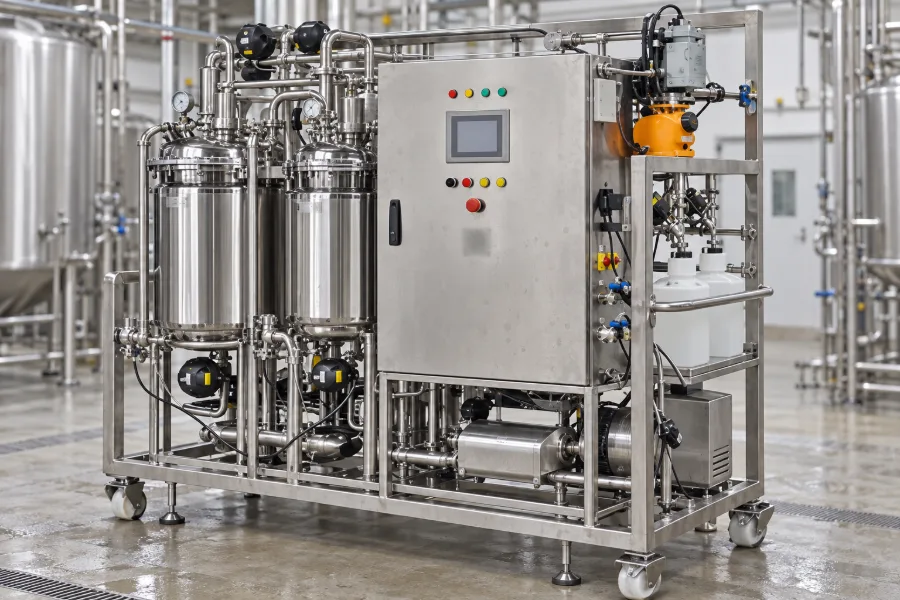
Pre-rinse, caustic, acid, final rinse and sanitize on one skid
Count the steps in a clean-in-place cycle and the heater works in almost all of them. A typical circuit runs a water pre-rinse to push out loose product, a hot caustic wash to lift fats and proteins, an intermediate rinse, an acid wash to strip scale and milkstone, a final rinse, and a sanitize step. The caustic and acid steps do most of the cleaning, and both lose strength quickly when the solution runs cool.
On most skids the heater is a shell-and-tube unit with steam on the shell and the cleaning solution in the tubes, heating the supply tank through a recirculating loop or heating solution in line. It sees every chemical the skid uses, at temperature, several times a day, and it is the one item on the skid cleaned by its own output.
Leading CIP skid builders in the US standardize on Enerquip exchangers, so many plants first meet the line as a heater already plumbed into a skid. The same design can be bought on its own, often from stock.
Request a Quote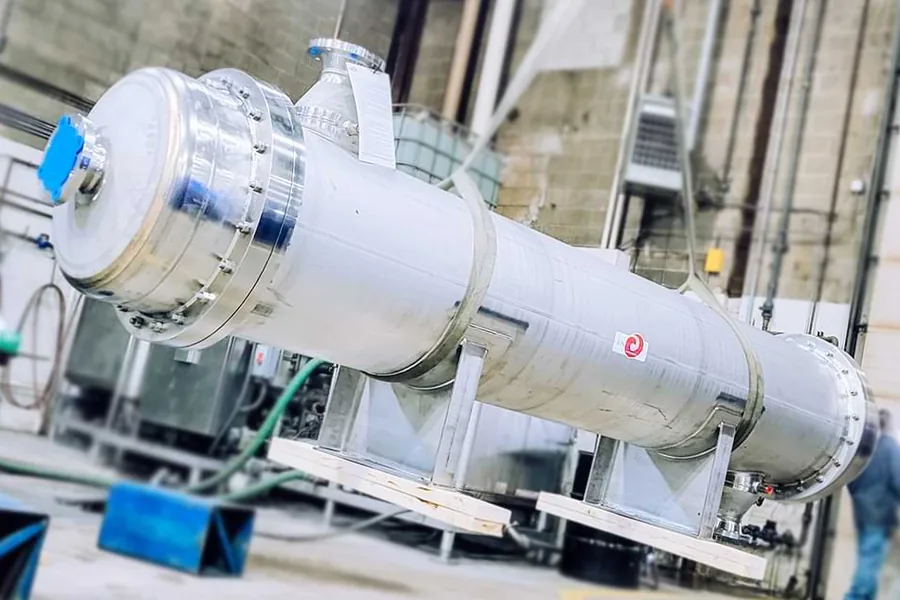
A CIP heater must be as clean as the line it washes
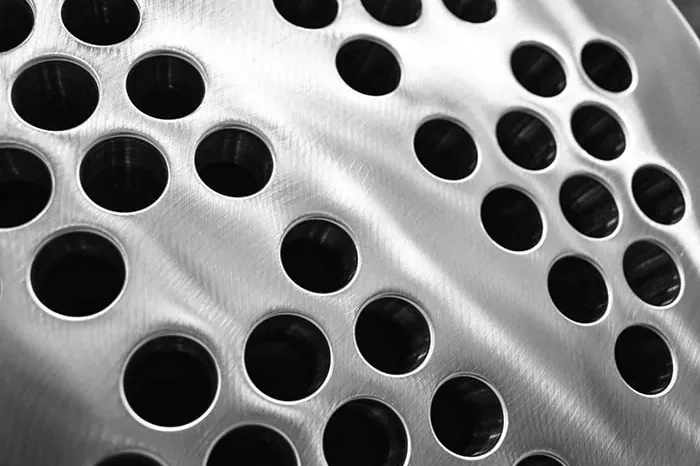
Solution leaves the heater at about 185 F and touches every surface in the circuit, so its tubes carry the same sanitary standard and finish as the process equipment: 32 Ra or better on a 3-A line.
Ready-made for the skid
- Stock BEU heaters in 4" to 10" shells
- Steam inlet on the shell, 1-1/2" to 4" NPT
- Two-pass tube side with tri-clamp ends
- Removable bundle sealed with O-rings
- Stock units often ship next business day
Built for caustic and acid
- Solution in polished, drainable tubes
- 32 Ra or better on 3-A product contact
- 316L/304L standard units for chloride risk
- Passivated in-house before shipment
- ASME stamped with a witnessed hydro-test
Which unit fits which part of the CIP circuit
The stock heater is the first answer wherever it fits; the rows below cover supply tanks, failed bundles and waste heat.
| DUTY | EQUIPMENT | WHY IT FITS |
| Heating wash solution | Stock BEU steam heater | Steam on the shell, solution in two-pass tri-clamp tubes, chosen from ten shelf configurations |
| 3-A or 316L circuit | Standard sanitary heater | 316L/304L in about 32 sizes up to 12" x 108"; the BEUB-3A-S models cover 3-A circuits |
| Heating a CIP supply tank | Bayonet tank heater | Goes into the tank through an existing flange and holds the batch at set point |
| Tube leak on an older skid | Replacement bundle and O-rings | Puts a sound shell back in service without repiping the skid |
| Heating make-up water | Waste heat economizer | Recovers heat from hot condensate or spent rinse before it reaches the drain |
What the chemistry and the steam do to the heater
Caustic is the gentle step for stainless. Hot sodium hydroxide at normal CIP strength does little harm to 304L or 316L; the main risk is a film left behind when the wash runs too cool to finish. Acid is where the alloy starts to matter. Nitric and phosphoric washes suit stainless and help keep its passive layer intact, but blends or sanitizers that carry chlorides attack that layer, and hot chlorides pit a tube from the inside.
That is the case for 316L, whose molybdenum resists chloride pitting better than 304L; the 3-A stock unit and the standard sanitary line are built in 316L/304L. A 304L stock heater serves well on a caustic and nitric circuit fed with low-chloride water. If chlorinated sanitizer passes through the heater, or make-up water is high in chlorides, specify 316L tubes and keep sanitizer out of the heater while it is hot.
Steam control decides how evenly the heater works. A modulating steam valve holds the outlet temperature as the return temperature changes. When it throttles hard near set point, shell pressure can fall below atmospheric, condensate stops draining and the lower tubes flood, and the heater bangs with water hammer at the next step. A vacuum breaker on the shell and a trap set below the condensate outlet keep it draining at every valve position.
Heat-up time is set by the coldest return. Early in each caustic step the solution comes back chilled by cold pipe and tank walls. Size it for that return temperature at the flow the spray devices need. A heater sized on the step average stretches every cycle out or cleans below temperature.
Water, energy and steam supply
Reusing the final rinse
Many skids capture the nearly clean final rinse in a recovery tank and use it as the next cycle's pre-rinse. That saves water and chemical, and recovered water arrives warm, so steam demand at the start of the cycle drops. Size the heater for a cold start anyway, because recovery tanks get drained for maintenance.
Heat that goes down the drain
Spent rinse water and hot condensate carry a surprising amount of heat out of a CIP room, and a waste heat economizer can pass some of it to incoming make-up water. Heat recovered from spent caustic needs a materials and fouling check first, because that stream carries everything the wash removed.
Mounting the heater to drain
A heater that holds water between cycles gives bacteria somewhere to grow and leaves diluted chemical against the tube wall. Mounted vertically with the bonnet at the bottom, the U-tubes empty through the bonnet; horizontal saddles work when the unit is pitched toward its drain. Recheck the pitch after installation, since a settled skid frame is a common reason swabs fail at the heater.
Hot water instead of steam
A plant without steam at the skid can run pressurized hot water on the shell instead. Hot water needs more surface: it gives up heat as it cools rather than by condensing, so the temperature difference to the solution is smaller and the heater needs more area or more passes. Four-pass standard units on 6" to 12" shells often cover it.
Sizing and running a CIP heater
Start with the supply flow the spray devices or line velocity require, the coldest return temperature at the start of a step, and the target supply temperature, usually about 185 F. Add the steam pressure available at the skid. With those four figures we can pick a stock size or tell you it needs a standard unit; sizing from tank volume alone usually comes out to small.
Enough that the steam temperature stays well above the 185 F solution target at full load, after the control valve takes its pressure drop. Lower pressure means a smaller temperature difference and more surface. Quote us the pressure measured at the skid, because piping and the valve take their share between it and the boiler header.
Yes. Many skids run a single heater and switch supply between tanks with valves, so it sees caustic, rinse water and acid in turn. Stainless handles that well when each chemical step is followed by a rinse. Trouble starts when the heater holds acid or sanitizer in a low pocket between cycles.
If the duty fits one of the ten stock configurations, a complete heater often ships the next business day; standard sizes typically ship in 6 to 8 weeks. When an Enerquip stock unit has failed only at the tubes, a stock bundle with fresh O-rings is quicker and cheaper still. Send the nameplate and we will tell you which path applies.
If your QA program holds the whole circuit to 3-A, yes. The heater is built to the same sanitary standard and finish as the equipment it cleans, and 3-A construction means 316L SA-213 seamless tubes, 32 Ra or better and an exposed gasket. The BEUB-3A-S stock and standard models are those units, including one 8" x 54" stock model. Name the 3-A requirement when you request a quote.
Related
Sanitary Applications
Personal & Pet Care
Personal care heat exchangers for lotions, creams, shampoos and pet food: sanitary 316L shell and tube with polished finishes and double tubesheets.
+ Learn More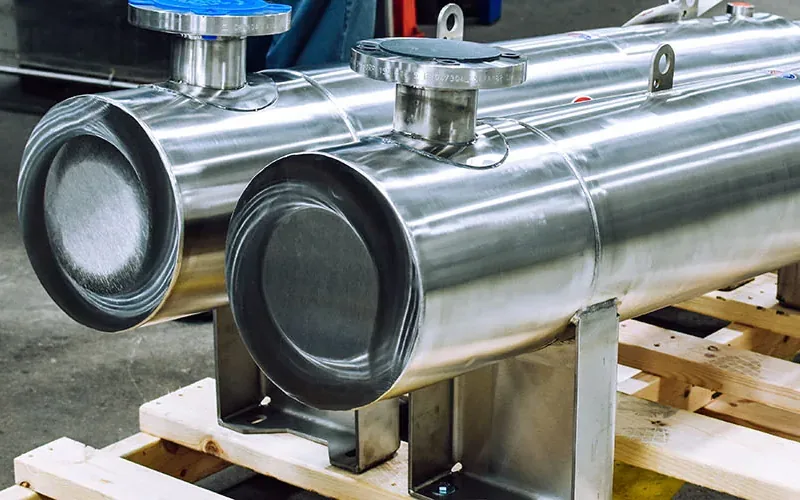
Sanitary Applications
Sanitary Shell & Tube
Sanitary shell-and-tube heat exchangers in 304L and 316L for food, dairy and pharma: product in the tubes, drainable, polished, built to 3-A when needed.
+ Learn More
Sanitary Applications
Dairy
Dairy heat exchangers that can be built to 3-A standard 12-08: CIP heaters, pasteurizing heaters and product coolers, with stock units ready to ship.
+ Learn More