
1-805-484-2992
Quotes - Engineering - SalesOne tubesheet lets the whole bundle grow freely
Put hot steam on the shell and cold product in the tubes, and any tube held at both ends is pulled against its tubesheets every time the unit heats up. A U-tube exchanger avoids that by bending every tube into a hairpin and fixing both ends in a single tubesheet. When the tubes run hotter or colder than the shell, they change length without pushing against anything, so there is no expansion joint to buy and no packed joint to leak. Remove the bonnet, unbolt the tubesheet and the bundle comes out of the shell in one piece. Enerquip builds stainless and alloy units in Medford, Wisconsin and carbon steel units in Beggs, Oklahoma.
This is the natural layout for steam-to-liquid heating, where saturated steam on the shell can sit far above the temperature of a cold product entering the tubes. A U-tube also suits a hot stream cooled by a much colder one, service that starts and stops several times a shift, and any duty where the outside of the tubes needs to be seen now and then. Product travels out and back along each tube, so inlet and outlet share one head.
The bends set the limits. A straight rod or brush cannot travel around a U-bend, so heavy tube-side deposits have to come off by chemical cleaning or a flexible lance, and hard scale in the bends may never come out completely. Tubes in the inner rows are boxed in by the rows around them; if one leaks it is plugged at the tubesheet rather than replaced. Keep a fluid that bakes on or carries solids out of the tubes, or choose straight tubes, and these limits rarely matter.
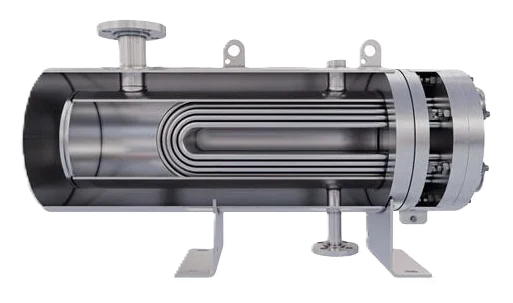
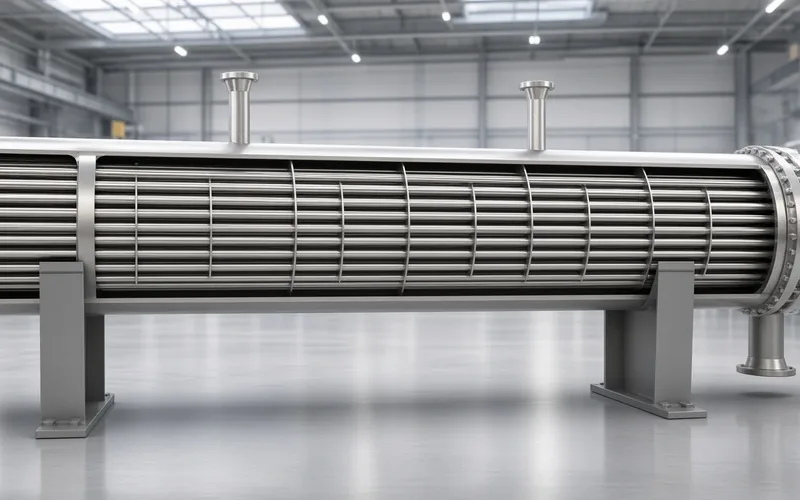
The U-bend is the expansion joint: every tube lengthens on its own, so a hot steam shell and a cold product never tear at the tubesheet.
Product or the cleaner fluid in the tubes; steam or the fouling fluid on the shell.
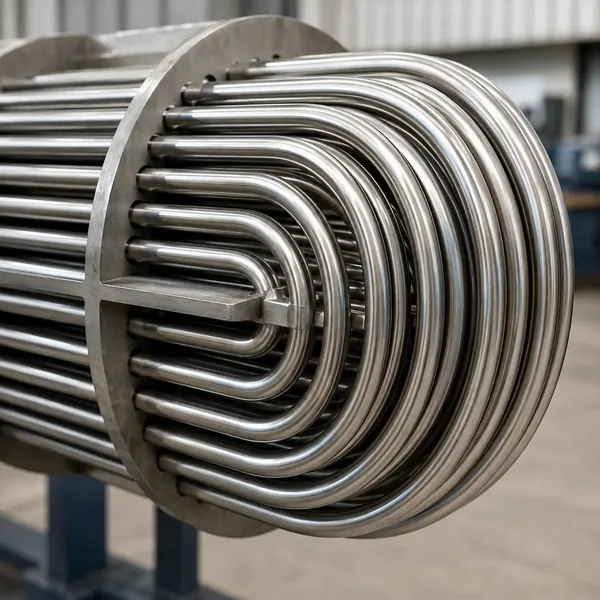
Built for a wide temperature gap
- Single tubesheet, no shell expansion joint needed
- Each tube lengthens freely around its own bend
- Steam on the shell meets a cold product inlet safely
- Tolerates frequent starts, stops and CIP cycles
- Two, four or more tube passes behind one bonnet
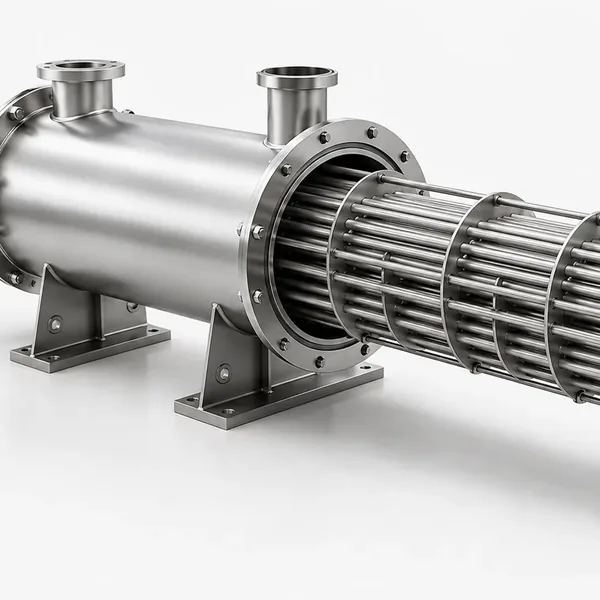
The bundle comes out whole
- Bundle withdraws from the bonnet end of the shell
- Shell bore and baffles open up for inspection
- O-ring seals on stock bundles for a fast swap
- Replacement bundles stocked for Enerquip units
- A spare bundle runs while the old one is cleaned
U-Tube Build Points


U-Tube Construction Options
From the stock BEU heater to a custom process unit, these are the U-tube choices Enerquip offers. The duty, the code and the pair of fluids decide which combination gets quoted.
| Option | Detail |
| TEMA type | BEU: bonnet front head, one-pass shell, U-tube bundle |
| Stock models | BEU and BEUB, two-pass tube side, 304L, 4" to 10" shells |
| 3-A models | BEUB-3A-S in 316L/304L, 32 Ra or better on product contact |
| Custom shells | To 48" diameter, larger depending on weight |
| Tubesheets | Single tubesheet, or double tubesheet with leak detection |
| Materials | 304L, 316L, carbon steel, duplex 2205 and 2507, Hastelloy, Alloy 20, Monel, AL-6XN, titanium Gr 2 |
| Connections | Tri-clamp product side, NPT steam side; ASME flanged or lap joint |
| Codes | ASME Section VIII stamp; TEMA B, C or R; 3-A, PED, CRN |
| Lead time | Stock often next business day; standard typically 6 to 8 weeks |
Choosing and Specifying a U-Tube Unit
Reading the BEU designation
Three letters describe the whole exchanger. In the TEMA naming system the first letter is the front head, the second the shell and the third the rear end. B is a bonnet, a one-piece cover that carries the nozzles. E is a one-pass shell, the most common type. U is the U-tube rear end: the tubes turn back inside the shell, so the far end is a closed shell cover with no second tubesheet or head. Enerquip's stock and standard sanitary heaters are BEU and BEUB units, and the 3-A models carry the BEUB-3A-S designation. A custom unit can pair the same bundle with a different front head, such as a channel with a removable cover.
Stock BEU or a custom U-tube
Most buyers holding one failed sanitary heater should start with the stock list. Ten configurations in 4" through 10" shells cover about 8.8 to 70.3 sq ft, all two-pass, TEMA C, ASME stamped and hydro-tested, and they often ship the next business day. About 32 standard designs stretch the range to 12" x 108" in 6 to 8 weeks. Custom U-tube units take over when the duty is more than steam on a clean product: a shell up to 48", an alloy for an aggressive utility, an ASME flanged industrial build, or a design to TEMA R for refinery service.
- Both fluids, their flow rates and inlet and outlet temperatures
- Steam pressure at the unit, or the supply temperature of the utility
- Allowable pressure drop on the tube side and on the shell side
- A nameplate photo, drawing or U-1 when an existing unit is being replaced
Sanitary or industrial build
The bundle shape stays; the details change. A sanitary U-tube unit keeps product in polished 304L or 316L tubes, ends in tri-clamp ferrules, drains through the bonnet and is cleaned in place. Medford handles stainless only, which keeps carbon steel contamination away from that work. An industrial unit trades the ferrules for ASME flanges, may be carbon steel built in Beggs, Oklahoma, and is often designed to TEMA B or R. Where one fluid fouls heavily, put it on the shell side, where the pulled bundle can be washed down from the outside.
When a second tubesheet pays
A U-tube bundle takes a double tubesheet neatly. Only one end of the tubes meets a tubesheet, so only one pair of sheets is needed, with a vented gap between them. A tube joint that starts to leak drips out of that gap, where someone sees it, instead of crossing into the product. Pharmaceutical and personal care plants specify it on purified water, WFI and product duties where a single cross-leak would cost a batch.
Call and talk it through with an engineer: 1-805-484-2992
Living with a U-tube bundle
By circulation rather than rodding. CIP solution or a chemical cleaning loop at proper velocity reaches the bends, and a flexible hydroblast lance can clear the straight legs. A rigid brush stops at the first bend. If the tube-side fluid leaves hard scale or baked-on solids, take it as a sign that the fluid belongs on the shell side, or that the duty belongs in a straight-tube unit.
It is plugged at both ends in the tubesheet. Inner rows have the tightest bends and sit behind the outer rows, so pulling and replacing a single tube there is not practical. Each plug takes a little surface away. Once enough are in, the unit stops reaching temperature, and a new bundle, kept on the shelf for Enerquip stock units, becomes the cheaper fix.
Because each tube leaves the tubesheet, turns at the bend and returns to the same sheet. A pass partition in the bonnet separates inlet from outlet, so all the product piping and the bundle pull happen at one end. Lay the unit out so that end faces open floor; the far end of the shell needs room only for it's support.
It tends to when the temperature difference is large. One tubesheet instead of two, and no shell expansion joint, take material and welding out of the unit. When the temperature gap is small and the tube side fouls, a fixed straight-tube design can win on price and on upkeep. We can quote both whenever the duty leaves the choice open.
Related
Heat Exchangers
Fixed Tube Exchangers
Enerquip fixed tubesheet, straight tube heat exchangers: tubes rodded end to end and replaced one at a time, single or multi-pass, sanitary or industrial.
+ Learn More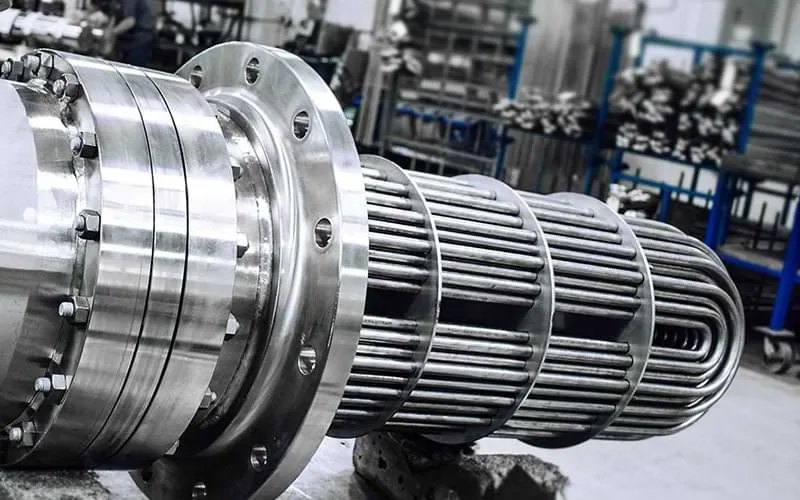
Heat Exchangers
Immersion Heaters
Enerquip bayonet immersion heaters warm a whole tank through a flange or manway it already has, with a removable bare or finned tube bundle.
+ Learn More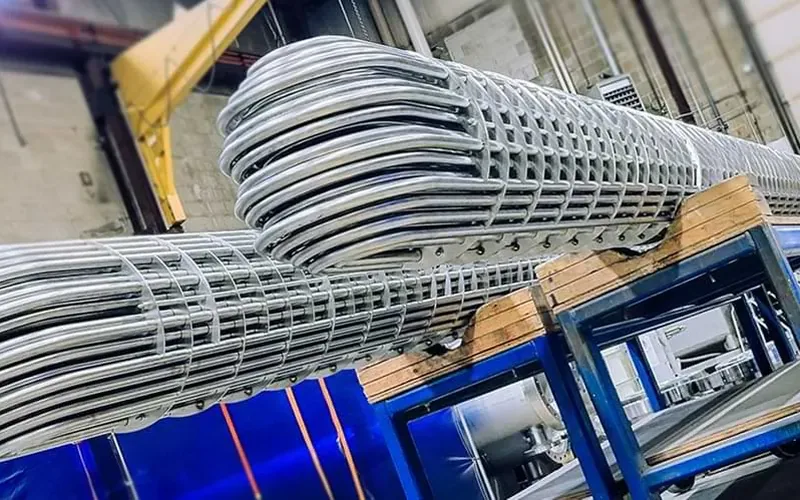
Heat Exchangers
Replacement Bundles
Replacement tube bundles, O-rings and gaskets for Enerquip exchangers, plus drop-in bundles built to your shell from a nameplate, drawing or U-1.
+ Learn More