
1-805-484-2992
Quotes - Engineering - SalesProcess heat for refineries and renewable fuels
Reboilers, condensers, interchangers, coolers and tank heating for hydrocarbon service
Crude is preheated against hot streams leaving the column, reboilers keep the column bottoms boiling, overhead condensers turn vapor back into reflux and product, and coolers bring naphtha, kerosene and diesel down before they reach storage. Enerquip builds custom shell-and-tube equipment for these duties within its size range, designed to ASME code, TEMA R or C, and API-660 when the project asks for it.
Renewable fuels plants have widened that work. Renewable diesel and biodiesel units heat vegetable oils, animal fats and used cooking oil through pretreatment, where free fatty acids and water can make a hot feed corrosive to carbon steel. Ethanol plants run multi-stage evaporation trains. Tank terminals heat heavy product in storage and again at the pump suction.
Shells run to 48" diameter, larger when the weight allows, in U-tube or straight tube construction with fixed, floating or double tubesheets. Process piping meets ASME / ANSI flanged, lap joint or NPT connections, and heavy bonnets can hang on davit arms or hinges so a crew can open them without a crane. Channel covers, twisted tape turbulators and non-asbestos, chloride-free insulation are specified the same way, duty by duty.
Request a Quote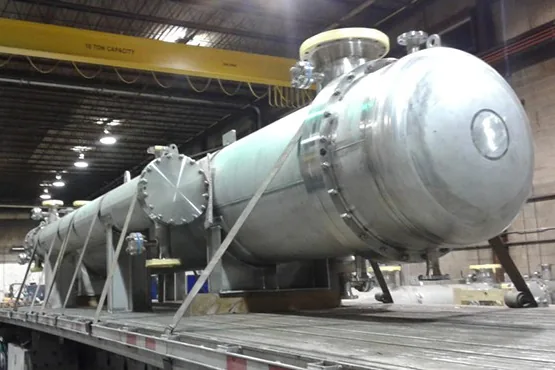
Refinery exchangers foul, run hot and wait for turnaround
Reboilers, interchangers and product coolers stay on line between turnarounds while they foul, so the design has to keep velocity up and leave a way in for cleaning.
Renewable fuels and ethanol
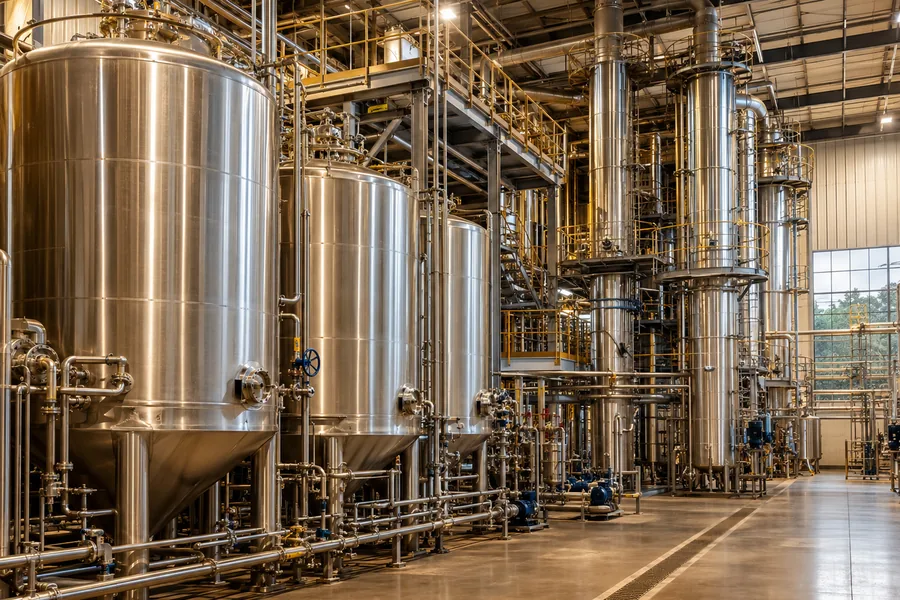
- Feed pretreatment heaters for oils and fats
- Multi-stage evaporation trains in ethanol plants
- 316L or duplex where free fatty acids attack
- Reboilers and condensers for distillation
- Waste heat economizers on hot product streams
Solvent and vapor recovery
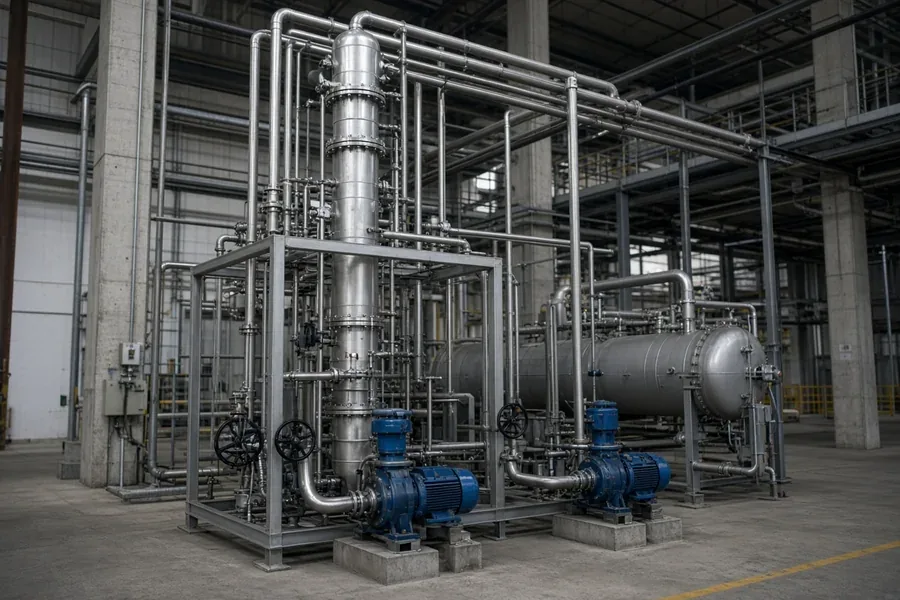
- Column overhead and reflux condensers
- Vacuum system condensers that unload the pump
- Emissions condensers that capture VOC vapor
- Hastelloy, AL-6XN or titanium for corrosive vapor
- Vertical or horizontal mounting at the column
Refinery and terminal duties, matched to equipment
Six duties that bring refinery, renewable fuels and terminal buyers to us, and the construction we would quote first for each.
| DUTY | EQUIPMENT | WHY IT FITS |
| Column reboiler | Kettle or thermosyphon reboiler | A kettle needs no set static head; a thermosyphon holds less liquid and responds faster |
| Feed/effluent interchange | Straight-tube interchanger | Heats incoming feed with the outgoing stream; the fouling stream goes in straight tubes that can be rodded |
| Overhead and vent condensing | Vapor condenser | Returns reflux to the column and captures light ends before they reach the vent |
| Cooling product to storage | U-tube product cooler | Brings naphtha, kerosene or diesel down before the tank, with a bundle that pulls for cleaning |
| Heavy oil at the tank outlet | Suction heater | Warms only the No. 6 oil or heavy crude as it is drawn off at the outlet |
| Holding a storage tank warm | Bayonet immersion heater | Enters through an existing nozzle or manway, bare or finned tube, and lifts out for service |
Designing for hydrocarbon service and corrosive feeds
Name the TEMA class and the code on the first inquiry. Refinery specifications usually call for TEMA R, and many add API-660 on top of ASME Section VIII; the industrial heat exchanger page explains what each class changes. Owner specifications also tend to fix flange ratings, nozzle orientation and the documents due at turnover, and a quote built without them gets priced twice. Each design is checked in Compress codeware and stamped after a third-party witnessed hydro-test.
Viscous product needs velocity or it will not heat. Heavy crude, No. 6 oil and vacuum residue are thick enough at storage temperature to flow laminar through a plain tube, and the heat transfer coefficient falls away. The usual answers are more tube passes, twisted tape turbulators to break up the slow layer at the wall, or putting the heavy oil on the shell side, where baffled crossflow transfers heat far better.
Let the corrosive stream choose the alloy. Carbon steel remains the default for clean hydrocarbon service. Chlorides, sour water and acidic condensate push toward duplex 2205 or 2507, AL-6XN, Hastelloy, Alloy 20 or titanium Gr 2, and routing that stream through the tubes keeps the upgrade on the tube side. Overhead condensers deserve the closest look, because acidic water tends to form where the first condensate drops out. Clad tubesheets and lap joint flanges can trim the cost of an alloy unit, as that page describes, and where 304L or 316L will serve, ask for a stainless price beside the carbon steel one.
Beyond the refinery fence
Tank terminals and heavy product
Terminals store residual fuel oil, heavy crude and other products that will not pump cold. A bayonet heater holds the whole tank warm and a suction heater heats only what leaves; the suction heater page compares the two. For a terminal quote, send the tank size, the product and its pour point, the heating medium on site and the nozzle or manway available, and we will size whichever heater the duty needs.
Carbon steel for hydrocarbon duty
Most clean hydrocarbon duties stay in carbon steel, built in Beggs, Oklahoma with the same code stamp and witnessed hydro-test as the stainless line. Put the corrosion allowance and any sour service requirements from the plant standard on the inquiry, so they are part of the first calculation rather then a revision. On water-cooled product coolers, say what the cooling water is, since its chloride level can decide the tube material even when the hydrocarbon would not.
Gas drying and LNG duties
Dehydration units dry natural gas with triethylene glycol, and a reboiler boils the absorbed water back out so the TEG can be used again; that reboiler runs hot glycol against a heating medium day and night. Refineries handling LNG use shell-and-tube vaporizers to turn the liquid back into gas, a duty where the cold end of the exchanger decides the metallurgy.
Replacing a bundle at turnaround
A turnaround window is fixed, and a leaking bundle found at inspection has to be back in the shell before it closes. We can match a drop-in replacement from the nameplate, a drawing or the ASME U-1 data report, and Enerquip builds it to the existing shell bore, nozzle locations and tubesheet dimensions, including on exchangers from other manufacturers. Custom bundles can be ready in as little as a few weeks, so order from the inspection findings rather than the restart date.
Refinery and terminal questions
A kettle reboiler holds a pool of boiling liquid in an enlarged shell and does not depend on a set static head from the column. A thermosyphon holds less liquid and responds faster to control changes, but it needs the right elevation between column and exchanger to circulate. Send the column elevations with the duty and we will tell you which one the layout supports.
Run the heating medium only as hot as the duty needs and keep the oil moving. Hot oil from a thermal fluid heater gives steady heat at a controlled temperature, and baffling or extra passes hold the velocity up. What usually goes wrong is high-pressure steam on a slow tank outlet, which bakes a layer onto the tubes that then insulates them from the product.
Sometimes, but check the feed first. Vegetable oils, animal fats and used cooking oil carry free fatty acids and water that can attack carbon steel, especially when hot. 316L is the usual step up, with duplex or a higher alloy where chlorides are present. Send a feed analysis with the inquiry, because the alloy choice follows from it rather than from habit.
One that stays tough at cryogenic temperature. Ordinary carbon steel turns brittle well above LNG temperatures, so the parts wetted by the liquid are normally austenitic stainless such as 304L or 316L, with the warm heating medium on the other side. Send the LNG flow, its pressure and the heating medium, and the design will show where the metal runs coldest.
Related
Process Applications
Suction Heaters
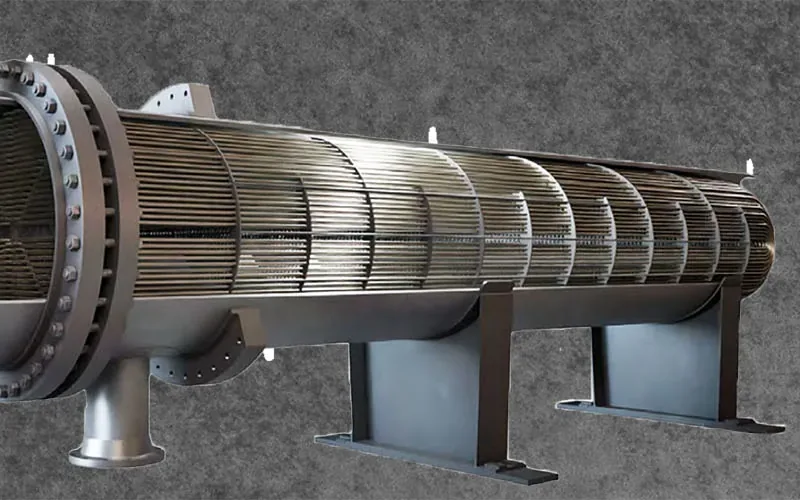
Enerquip tank suction heaters warm only the product leaving the tank - heavy fuel oil, molasses, tallow, wax - with a removable steam or hot-oil bundle.
+ Learn More
Process Applications
Pharmaceutical
Pharmaceutical shell and tube heat exchangers for WFI, CIP and bioprocess duties: 316L tubes at 25 Ra or better, electropolish and double tubesheets.
+ Learn More
Process Applications
WFI Exchangers
WFI heat exchangers for water-for-injection and purified water loops: point-of-use coolers, loop heaters and pure steam condensers in polished 316L.
+ Learn More